February 6, 2026 · When you take out the trash, do you ever think about its journey?
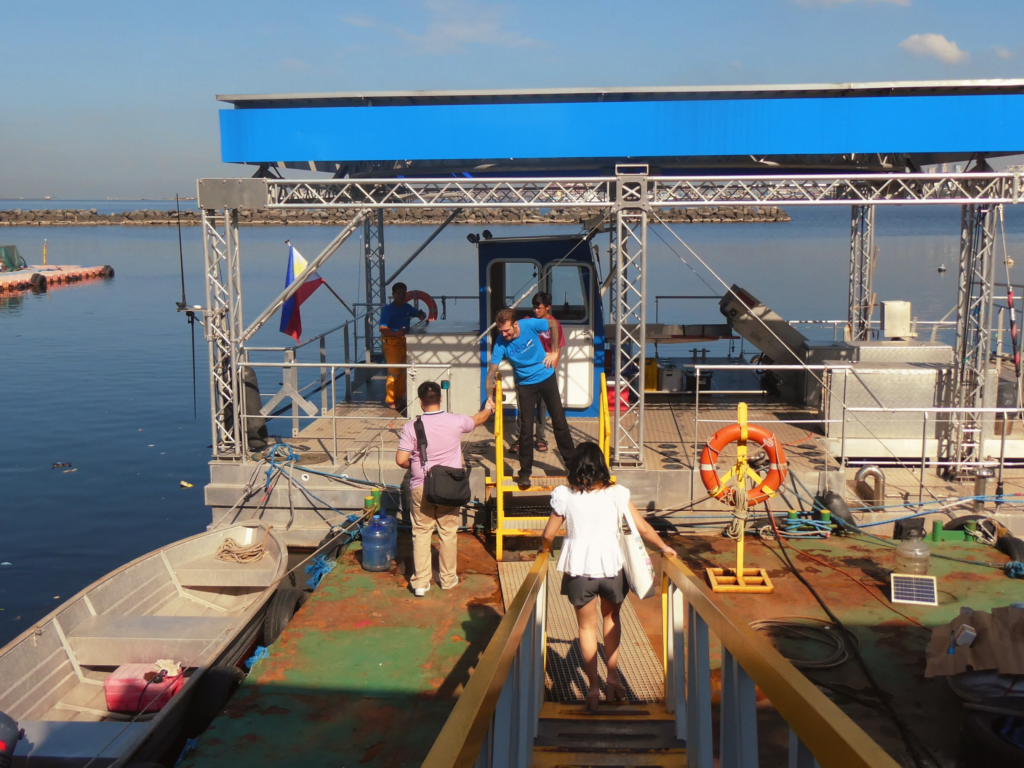
For Daniel Scheler, the answer has always been yes. Growing up in East Germany, he was hailed the back-to-back Garbage Champion in local recycling competitions—a title he wears with pride. Now, as the Captain of the SeeCow of One Earth One Ocean (OEOO) Manila, he and his crew sail Manila Bay, collecting 200-500 kg of trash every day, setting it back on course to becoming treasure.
The SeeCow is designed to leave no waste behind. Running fully on solar power, it sucks up trash from Manila Bay’s waters and automatically pulls it onto a conveyor belt, to be manually sorted by the crew. The sorted garbage is then chucked into bags and picked up by the SeeCow‘s recycling partners.
When asked if they lose visibility after handing over the trash, Scheler says “not exactly,” noting that he has watched the sorting process firsthand. “[The recyclers] sort everything which can be further recycled,” he explained. “What can’t be recycled gets prepared differently. They prepare it by shredding it into small pieces, drying it, and feeding it into cement kiln flames.” The temperatures are high enough to substitute for coal, saving fossil fuels in the process.
This is what he refers to as an end-of-pipe solution, a form of waste-to-energy. The topic is an ongoing debate, particularly in the Philippines where industrially regulated waste-to-energy facilities is still a burgeoning, looming possibility.
On the boat, skids made out of 100% recycled plastic, the very material his vessel beaches itself on.
Unlike natural ecosystems, which typically operate in cycles—take, for instance, the forest floor where what dies becomes dirt becomes dinner becomes deer becomes, eventually, dirt again—the modern industrial economy is linear. We drill oil from ancient seabeds, then turn those fossil fuels into the power source of vehicles, power plants, and factories—sending carbon up smokestacks that thicken the atmosphere. (In 2025, the Global Carbon Project projected that fossil fuel CO2 emissions would reach an all-time high, topping 38 billion metric tons.)
The extracted oil is a primary raw material for making plastic. Think bottles, bags, toys, packaging containers. Some used once, others used until they wear out and are eventually thrown away, whisked off alongside the 23 million tons of plastic—the weight of about 440 Titanic boats—the global economy generates annually. They accumulate in landfills and oceans, breaking down into smaller and smaller pieces but never actually disappearing. They don’t rejoin any cycle. Their journey is a straight line with no loop back to the beginning.
Burning plastic for cement production is one way to intercept it along that linear path.
When asked about the downsides, Scheler doesn’t dodge the question. “I’m not against it, but I’m also saying, hey, it’s not a perfect thing because of the CO2 emissions.”
For Scheler, despite the consequences of waste-to-energy, the alternatives are worse. Landfills produce methane (a greenhouse gas more potent than carbon dioxide) under oxygen-free conditions. And ocean dumping would be catastrophic for an ecosystem we can’t afford to lose.
“The ocean is our biggest carbon sink and our biggest oxygen producer. There’s nothing better than our ocean. If we screw that up, there’s no turning back.”
Daniel Scheler
Scheler’s work exists in a rapidly evolving policy landscape. Since July 2022, the Philippines’ Extended Producer Responsibility Act has required large companies (those with assets exceeding 100 million pesos) to recover an increasing percentage of their plastic packaging waste: 20% in 2023 and incrementally escalating to 80% by 2028. They’re encouraged to partner with organizations that can provide the collection infrastructure and verification they need. On paper, OEOO Manila fits seamlessly into this framework.
But in practice, funding remains elusive. The SeeCow—plus its other maritime waste collection vessel relatives known as the SeeHamster and SeeElefant—largely operates on private donations and partnership support, paying operational costs just to keep the boat moored. What would change the equation? More formal partnerships. The boat is currently running, but on borrowed time and borrowed money, yet it offers precisely what corporations need to meet their legal obligations.
Some connections, though, are starting to form. Fortunately, with their new corporation partner, Philippine Transmarine Carriers, Inc. (PTC), OEOO Manila is connecting with a broader network of recyclers, including Evergreen Labs. The promise: turn collected plastic into granulate, which can then become building materials, furniture, packaging, crates, and even 3D printing filament.
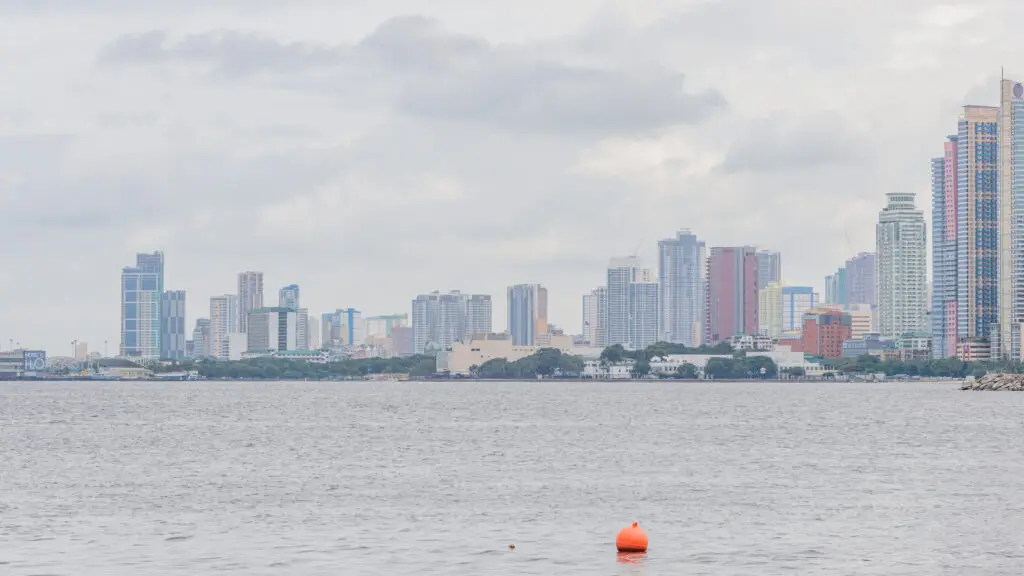
These days, littering remains prevalent around Manila Bay. Kids drop wrappers mid-bite. Friend groups leave their snacks behind. Drivers toss garbage out car windows. To them, these small acts are instinctual, too small to matter. But one quick glance at the water shows the sum of those little things: Purefoods ready-to-eat packages, 3-in-1 coffee packets, silver shampoo sachets.
“It is, unfortunately, still totally normal to [litter]. They haven’t been taught differently for the rest of their lives,” Scheler said. “Lower-income families have so little that they, in some cases, don’t have a second t-shirt. They are literally fighting for survival on a daily basis, so they have other problems than garbage segregation or proper discarding of garbage. I can understand that to a certain extent too.”
Roxas Boulevard along Manila Bay remains a popular spot to watch the sunset.
He’s blunt about what OEOO can and cannot change. “We cannot change anything about equality. We cannot change anything about the gap between rich and poor.”
What OEOO can do is quietly build the infrastructure and hope for a transformation.
Educational modules developed with schools give teachers and students the tools to understand the problem. Scientific data collected on the boat creates a compelling story that can inform policy. Corporate CSR events bring employees face-to-face with the crisis. And crucially, their organization connects stakeholders—scientists, corporations, educators, government—who can enable systemic change.
For Scheler, there’s no time to waste. By 2050, some scientists project there will be more plastic in the ocean than fish by weight. So every day we continue with business as usual, we are choosing a dead ocean.
A dead ocean brings us to the doorstep of a dying planet, one that can no longer regulate its own climate, feed its people, or produce the air we need to survive.
That’s why we need a total course reversal. And that includes the course of your trash itself.
Scheler can tell you exactly where his 500 kg of trash goes. But most of us probably can’t say the same about the plastic bottle we threw away yesterday. Odds are, it’s already on a months-long, archipelagic journey, moving towards its final resting place.
So the next time you take out the trash, you might want to think twice. Or at least wish it safe travels. It still has a long road ahead.
OEOO Manila is seeking long-term mooring and docking partnerships. If you or your organization would like to support their mission for plastic-free oceans, contact Daniel Scheler at daniel.scheler@oneearth-oneocean.de.
Ana Amistad is a strategist at Sustina, and a relentless asker of questions. Before joining the non-profit, she spent years marketing brands across Asia, the United States, Australia, and Europe, leading strategy and campaigns from the ground up.
'Filipinos have more than earned the right to be skeptical and to scrutinize the national budget, especially the proposed flood control projects of more than ₱103 billion.'