


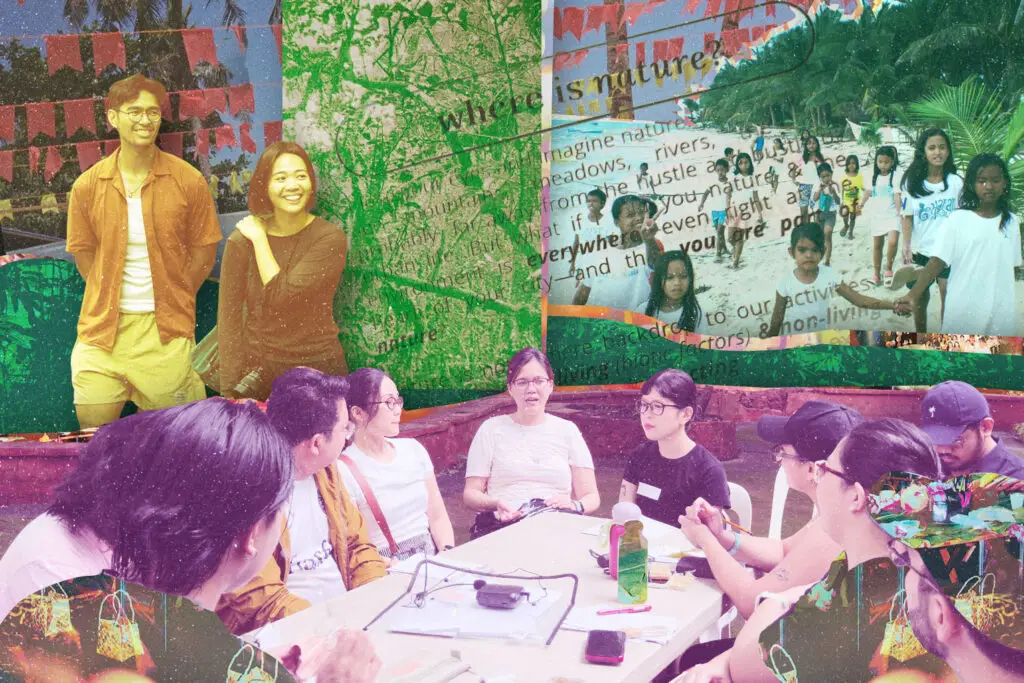





January 15, 2026 · A founder of a specialty coffee shop employing families of victims of extrajudicial killings sat across a founder building sustainable housing for low-income families. In another table, the owner of a food condiments and juices company talked to a telemedicine founder about marketing and procurement timelines. In the corner, a climate tech founder stared at a wall covered in sticky notes describing pressures that sounded nothing—and yet, exactly—like hers.
By lunch time, a pattern emerged: these founders were strained under conditions they themselves had created—not from insufficient commitment, but from complete absorption. From equating organizational outcomes with self-worth. From shouldering emotional loads their structures were never designed to distribute.
This report documents the Sustainability for Founders Workshop held on December 4, 2025, which we designed and delivered in partnership with the Asian Institute of Management-Dado Banatao Incubator (AIM-DBI). It presents five insights on how founder capacity degrades, and five tensions about the structural forces accelerating that degradation.
Beyond the question of how to make founders more resilient, this workshop revealed a deeper insight: The conditions in which founders operate in systematically erode their capacity to sustain their work.

Insight 1: The relational closeness that validates the startup becomes the ceiling that prevents growth.
Founder-led startups begin with intimate operations—direct relationships with those they serve, decisions made through personal judgment, processes built around specific people and their networks. This closeness drives early success: trust forms quickly, the mission stays clear, and responses happen fast.
These same strengths create hard limits at scale. What worked for ten people fails at one hundred. Founders see the problem clearly: the organizational structure that proved their concept now blocks expansion. Growth requires rebuilding from founder-centered to system-centered operations, but this threatens the relationships that keep stakeholders committed and the identity that defines the organization.
Insight 2: Measured distance from specific outcomes protects founder capacity in environments that resist change.
Founders typically operate with complete commitment—tying their self-worth to organizational performance, taking institutional resistance personally, sacrificing relationships and health to keep operations running. This pattern degrades predictably: mental load accumulates, decision-making suffers, and resilience breaks down under sustained pressure.
Some founders demonstrate a different approach: deliberate indifference to certain operational pressures while staying committed to the core mission. This boundary-setting separates what truly matters from what does not. When external conditions (government opposition, funding constraints, cultural pushback) remain fundamentally unchanged, treating every outcome as personal creates vulnerability rather than strength. Strategic distance acts as protection, enabling sustained performance when the environment stays hostile.
Insight 3: Co-founder misalignment on sustainability and pace creates internal friction that mirrors external pressures.
Workshop data revealed that no two co-founders are the same in their vision and commitment to sustainability. Founders united by mission may diverge on execution philosophy, creating decision-making paralysis at precisely the moment when organizational transformation is required.
This internal misalignment is not incidental but reflects the broader tension between agility and stability that defines the growth challenge. The startup faces external pressures demanding both rapid adaptation and systematic stabilization, but the founding team itself embodies this contradiction without resolving it.
Insight 4: Founders treat problem symptoms rather than root causes, dispersing their energy across shockwaves instead of epicenters.
The Seismic Canvas exercise revealed that founders have been spending their energy treating the shockwaves, instead of the epicenter (core pressure). Founders identify their core pressure as a “chicken and egg” problem—multiple structural issues reinforce each other without clear entry points for intervention.
This pattern produces operational firefighting: responding to urgent manifestations of deeper structural problems without addressing underlying architecture. The result is that founders continuously expend energy on secondary effects while foundational tensions remain unresolved and continue generating new crises. (Read: Insights: ‘Design Thinking for Sustainability’ by Sustina Lab)
Insight 5: Founders mistake velocity for resilience, confusing operational agility with structural stability.
Operating without management policies means every decision becomes a fresh negotiation, burning cognitive resources while creating the illusion of agility. Founders frame their challenge as choosing between dynamic flexibility and fixed processes (“agility versus stability” and movement “from guerrilla-type to tech-driven business model”), but this framing misdiagnoses the problem.
The issue is not speed of response but absence of foundational infrastructure. The current model conflates responsiveness with sustainability when these require different organizational capabilities. True resilience requires stable core systems that enable selective flexibility, not perpetual improvisation.
Sustainability for founders will not come from working harder or moving faster. It will come from redesigning how their organization holds responsibility, decision-making, and emotional load.

Tension 1: Mission design can create operational conflicts that grow worse at scale.
Some startups exist to deliver dignity and quality to marginalized people regardless of their economic status. But turning this mission into operations creates built-in tensions.
One group provides funding while another receives services, creating conflicts for the founder. Funding sources expect different things than service recipients need. Maintaining high ethical standards creates friction with stakeholders who expect conventional trade-offs between cost and quality. Ethical commitments that refuse quality/cost trade-offs create margin constraints that threaten organizational viability, forcing founders to choose between mission integrity and financial survival.
Staff members recruited from beneficiary communities bring trauma that manifests in workplace behavior, requiring support the organization was not built to provide. The mission aims to help people move beyond trauma and rebuild identity, yet daily operations keep reinforcing the same traumatic patterns. This is not about compromising values. It is recognizing that mission purity and business sustainability exist in tension rather than natural agreement.
Tension 2: Government barriers, not market competition, can determine whether the startup survives.
Founders spend almost no time analyzing competitors—no discussion of rival businesses, alternative products, or competitive advantage. Instead, energy goes to institutional navigation: building trust with local government officials, managing different regulatory processes, negotiating cultural expectations about who deserves what.
In some cases, the government determines viability by setting boundaries on which populations should access which quality of services. Cultural beliefs assign poor people to “appropriate” offerings for their status, creating ethical opposition to providing equal quality. Each government unit follows its own processes, multiplying work without creating a competitive edge.
This changes the fundamental challenge: staying power matters more than innovation, institutional patience matters more than product features. The startup is not competing for market share but for permission to exist within current power structures.
Tension 3: Short-term survival demands conflict with long-term capability building.
Founders recognize the need for staff development programs and skill-building, yet operate under cash flow constraints and high burn rates that make investment in people difficult. Financial pressure creates bias toward immediate execution over capacity development.
Changing stakeholder mindsets—farmers focused on short-term gains, customers resistant to new approaches—requires sustained relationship investment that founders cannot afford while managing daily survival pressures. There is awareness that staff need to move from trauma-informed behavior to professional capability, but the financial reality prevents this transformation.
Tension 4: Technical capability and advocacy orientation exist as opposing extremes rather than integrated strengths.
The observation that “people are on the extremes: too technical and too advocacy driven” reveals an organizational split. Rather than blending technical execution with mission commitment, teams polarize into camps.
This fragmentation likely mirrors the co-founder dynamic tension and creates operational inefficiency—technical staff may resist mission-driven constraints while advocacy-oriented staff may dismiss operational realities. The startup needs both orientations working in concert, but the organizational culture has separated them into competing rather than complementary forces.
Tension 5: Identity transformation is mission-critical but organizationally unsupported.
Some startups aim to enable beneficiaries to move beyond vulnerable identities toward capable, healed individuals. Yet the organizations lack the therapeutic infrastructure, management systems, or staff training to support this transformation. Trauma manifests in workplace behavior, creating conflicts the organization cannot resolve because it was designed for service delivery, not healing facilitation. Staff development programs are recognized as necessary but remain unfunded.
The gap is fundamental: the mission requires identity reconstruction work, but the operational model assumes beneficiaries arrive pre-transformed and ready for professional integration. This mismatch means the organization continuously encounters problems it has no capacity to address.
Founders are not strained because of weak execution or insufficient commitment. They are strained by unresolved design tensions embedded in their operating environments and organizational models.
Founders must stop treating these tensions as temporary obstacles and begin designing explicitly around them. More than optimizing performance, sustainability for these founders is about building organizations strong enough to hold contradictions without breaking.
Email editor@sustina.earth to access the full report.
The Asian Institute of Management-Dado Banatao Incubator (AIM-DBI) is a hybrid DOST-PCIEERD technology business incubator-accelerator that targets innovation-driven entrepreneurs whose businesses have the potential to impact all sectors of society in Asia. We give world-class mentorship from AIM community of faculty and alumni, incubation partners, and networks of founders and industry leaders; a hands-on education and customized training programs to all qualified startups.