






May 26, 2026 · The Philippines belongs to the top five biodiversityGlobal EssentialsBiodiversityThe variety of life at genetic, species, and ecosystem levels. Biodiversity loss is a material financial risk and a prerequisite for nature-positive investment frameworks.Read more in the Glossary → hotspots in the world, with the greatest concentration of unique species per unit area in the world, according to the national Biodiversity Management Bureau.
But with so many of those species under threat, many of them have been lost; when the conditions are right, sometimes they are rediscovered.
What is a ‘lost species’?
A lost species is one that has not been observed in the wild for 10 years but has the potential to be rediscovered, according to the Journal of Lost Species.
But being “lost” does not mean extinct. Just because they are difficult to find or have not been searched for, it does not mean that stable populations don’t exist. It just means there hasn’t been confirmation of life for 10 years.
Wildlife biologist Kier Mitchel Pitogo, who rediscovered the lost Guttman’s stream frog, stated that it is “really challenging” to find lost species compared to new ones. New species, he said, are “almost guaranteed” to be found when you go to a forest.
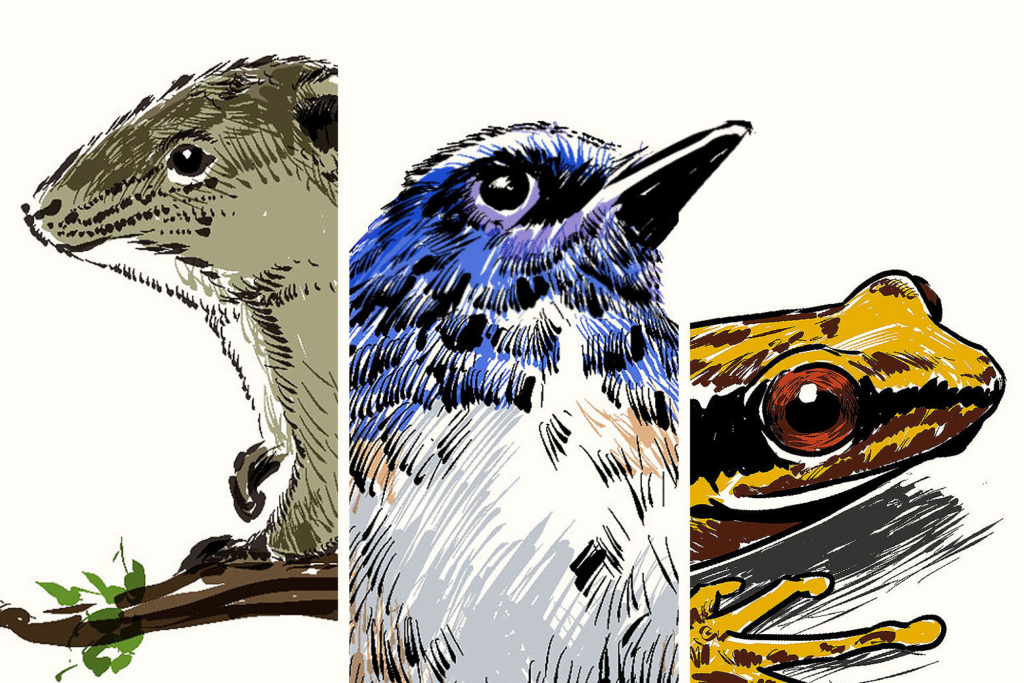
Below, we’ve compiled a list of lost species that have inspired conservation with their rediscovery across Philippine sanctuaries and mountains. From a rare amphibian to a flower species lost for over 130 years, here are some notable species that have recently come out to say hello.
The Short-footed Luzon Tree Rat

The Short-footed Luzon Tree Rat (Carpomys melanurus) was rediscovered in 2008 by a group of researchers led by Filipino Biologist Dr. Danilo Balete and Lawrence Heaney of the Field Museum in Chicago. It is a small rodent species that can be identified by features such as reddish-brown fur, black coloration around large dark eyes, and a long dark-haired tail.
It was first discovered on Mount Data by British researchers in 1986, where Heaney stated that “there is virtually no forest left.” It was found again on Mount Pulag, the highest point in Luzon, atop a large tree canopy. Mammal collection manager William Stanley at the Field Museum described its rediscovery as “hope for conservation.”
Dinagat Bushy-tailed Cloud Rat

While surveying Dinagat Island tarsiers, Czech zoologist Milada Řeháková and her husband, Vaclav Rehak, encountered what they described as a “huge, hairy, grey-brown rat.” This turned out to be the Dingagat Bushy-tailed Cloud Rat (Crateromys australis), a lost species last captured in 1975. It was not seen again until 2012.
It is critically endangered and endemicLocal Climate & EcologyEndemic speciesFlora and fauna restricted to a specific geographic region. For environmental impact assessments and biodiversity offsets, the presence of endemic species elevates the ecological sensitivity of a site, often triggering strict regulatory prohibitions on land conversion and requiring highly localized conservation interventions.Read more in the Glossary → to Dinagat Island, Philippines, which was officially proclaimed a mineral reserve roughly 80 years ago. Nickel mining and logging have caused extensive habitat destruction with no formally designated protected areasPH Laws & FrameworksProtected areas (NIPAS)Lands and waters legally set aside for conservation under the National Integrated Protected Areas System (NIPAS), from national parks to protected seascapes.Read more in the Glossary →.
Řeháková expressed happiness over the impact of her discovery and stated that the rodent was “a unique species that is not found anywhere else on this planet and deserves protection.”
Guttman’s Stream Frog

Guttman’s Stream Frog (Pulchrana guttmani) was rediscovered in 2021 in the forest of Mt. Busa in southern Mindanao with the help of local guides from the indigenous T’boli. The species “eluded scientists for decades,” making its rediscovery a huge success for Filipino biologists and conservationists.
University of Kansas researcher Rafe Brown first came across Guttman’s Stream Frog in 1993, when he and his team came to visit Mount Busa in Southern Philippines. Brown noted that during their visit, they witnessed commercial logging, which he described as “absolutely heartbreaking.” Brown first introduced P. guttmani to the public in a study published in 2015, after DNA sequencing confirmed it was unique.
It is possibly one of the rarest amphibians in the world as it has “the most restricted geographic range of any Philippine ranid frog.”
Rufous-breasted blue flycatcher

On March 9, 2025, experienced birder Martin Kennewell decided to take a chance by playing the song of a close relative of the rufous-breasted blue flycatcher (Cyornis camarinensis) while exploring Caramoan National Park. He was rewarded with the sudden appearance of the rare bird, previously considered a lost species, which had last been seen in 2008.
The rufous-breasted blue flycatcher was photographed in March 2025 for the first time after 17 years. Little is known about this species other than that it is endemic to the south-eastern peninsula of Luzon, Philippines. It is currently classified as a vulnerable species, also due to habitat loss from mining and logging.
Sulu cuckooshrike

While searching for the Sulu Hornbill—one of the rarest critically endangered birds in the world—Shareef Khaddafi Hairal and his team spotted what they described as a “dark bird.” After images were uploaded to Facebook, Philippine bird expert Desmond Allen identified it as the Sulu Cuckooshrike (Coracina guillemardi), which he had last seen in 2008.
First discovered in 1886 in the Sulu Archipelago, it was previously classified as a subspecies of the Bar-bellied Cuckoshrike, then recognized as a distinct species in 2024. Research attributes the difficulty in documenting the species to the ongoing conflict in the Sulu Archipelago.
Exacum loheri (H. Hara) Klack

On December 8, 2023, a group of biologists from the University of the Philippines Diliman and Philippine Normal University unknowingly rediscovered a lost species while conducting reconnaissance fieldwork on snail habitats within Masungi Georeserve. Just last year, it was identified in a paper published in the Philippine Journal of Science, confirming that it was Exacum loheri (H. Hara) Klack, a species last recorded in the 1890s.
That means it had been lost for 130 years before being officially rediscovered. It is achlorophyllous, meaning it does not produce energy via photosynthesis due to the absence of chlorophyll; instead, it relies on a symbiotic relationship with fungi to obtain nutrients.
What happens after a species is lost?
Six bird species are expected to be declared “lost species” in 2026, including the Mindoro bleeding-heart (Gallicolumba platenae) and Mindoro imperial pigeon (Ducula mindorensis), which were last seen in 2005 and 2016, respectively.
The rediscovery of lost species brings hope to researchers and leads to demand for new conservation measures, such as the establishment of new protected areas. The rediscovery of Exacum ioheri (H. Hara) Klack in Masungi Georeserve suggests that active conservation management can create conditions for lost species to persist—or be found again.
Previously, the rediscovery of the Dinagat Bushy-tailed Cloud Rat quickly led to the declaration of the Mount Kambinliw and Mount Redondo Key Biodiversity Area (KBA). Most of the island had already been cleared for mining and logging, but a few forested areas remain and are now protected to preserve the species that live there.
After the rediscovery of Guttman’s Stream Frog, the Busa mountain range was proposed as a protected area. It is also home to the critically endangered Philippine eagle, which furthered efforts to declare it as a national protected area. While this proposal was pitched to the Department of Environment and Natural Resources (DENR) in 2021, the initiative has yet to take effect.