


June 8, 2026 · Editor’s Note: This World Oceans Day, we can’t help but think about water—how it carries life, how it sustains it, and how often we take it for granted. As we brace for a stronger El Niño that threatens the very DNA of our planet, our strategist speaks to water expert Francelline Jimenez to understand when the world started running out of water—and what we can still do to save it.
When my parents told me to turn off the faucet to “save water,” I didn’t know it was because the world was risking its bankruptcy. The thought that the world could run out of water had never even crossed my mind.
All I knew was that if you looked at a photo of the Earth, you’d see a perfectly round marble suspended in black, with swirls of white and jigsaw puzzles of brown and green, and then the negative space filling in everything else: all blue. All water.
It looks like there’s plenty.
But the United Nations says otherwise. In January 2026, through a 72-page report titled “Global Water Bankruptcy: Living Beyond Our Hydrological Means in the Post-Crisis Era,” they announced that humanity had officially entered the era of global water bankruptcy. Not a crisis—a bankruptcy.
For decades, scientists, activists, and documentary filmmakers warned about a global water “crisis”—a term that, by its very nature, implies a temporary state.
But the emphasis on “bankruptcy” explains a state where we’ve exhausted renewable water supplies to the point of no return. This led me down a rabbithole: what do you mean we’ve run out of water?
I got to have a conversation with Francelline “France” Jimenez, Director of Operations at Waves for Water Philippines—a non-profit organization dedicated to providing immediate and long-term clean water access to remote, underserved, and disaster-affected communities across the country—who has been watching the signs of water bankruptcy accumulate for years.
“When we go around and do projects, I always ask communities: where do you get water?” she said. The answer, almost always, is groundwater—from a poso, a well dug deep into the earth. And in more and more places, that groundwater is gone.

While about 70% of the Earth’s surface is water, only about 3% of that is freshwater, the kind we can drink, cook with, and grow food in. And of that 3%, about two-thirds is locked in glaciers and snowfields. What remains—rivers, lakes, accessible groundwater—is the sliver of the planet’s water supply that 8 billion people are trying to survive on.
The math behind water bankruptcy
With these numbers in mind, you can think of water bankruptcy like financial bankruptcy. Your water income is your “checking” account: the rainfall, river flows, and surface water that nature regenerates on a reliable cycle. It comes in, you use it, more comes in. That’s the system working as designed.
Your groundwater reserves (the water stored in aquifers deep underground, accumulated over thousands or even millions of years) and glaciers (the ancient frozen stores of freshwater sitting atop the world’s mountains) are part of your “savings” account. They are not meant to be your daily spending money. They are the reserve you dip into in emergencies, slowly and carefully, with the complete understanding that they take an extraordinarily long time to replenish.
Think of water assets like your finances: Water stress is when you overspend your income—painful, but recoverable. A water crisis is when you max out your checking account and dip into your savings. Water bankruptcy is when you’ve liquidated your savings account entirely.
Clearly, humanity has been overspending for a long time.
Since the early 1990s, more than half of large lakes and reservoirs worldwide have become smaller. Over 35% of the world’s wetlands, the kidneys of the Earth, have been lost since 1970, driven by farming, construction, pollution, excessive fishing, and resource extraction.
In that same period, Earth’s glaciers have shed 9,179 gigatonnes of water. These are the world’s water towers: they store frozen precipitation and release it as meltwater to feed the rivers and streams that billions of people depend on. Lose the glacier, lose the river. Lose the river, lose the farm. Lose the farm, lose the food.
Overall, the world is losing 324 billion cubic meters of freshwater (roughly the size of 130 million Olympic swimming pools) to worsening droughts and unsustainable human practices like poor water pricing policies, weak cross-sector coordination, and a widespread shift toward cultivating more water-intensive crops in regions that are already drying out.
We have been spending beyond our hydrological means for so long that the planet’s natural credit has run out. Unfortunately, we’re still acting like we can put it on the tab.

Bargaining in the Philippines—what’s the last price?
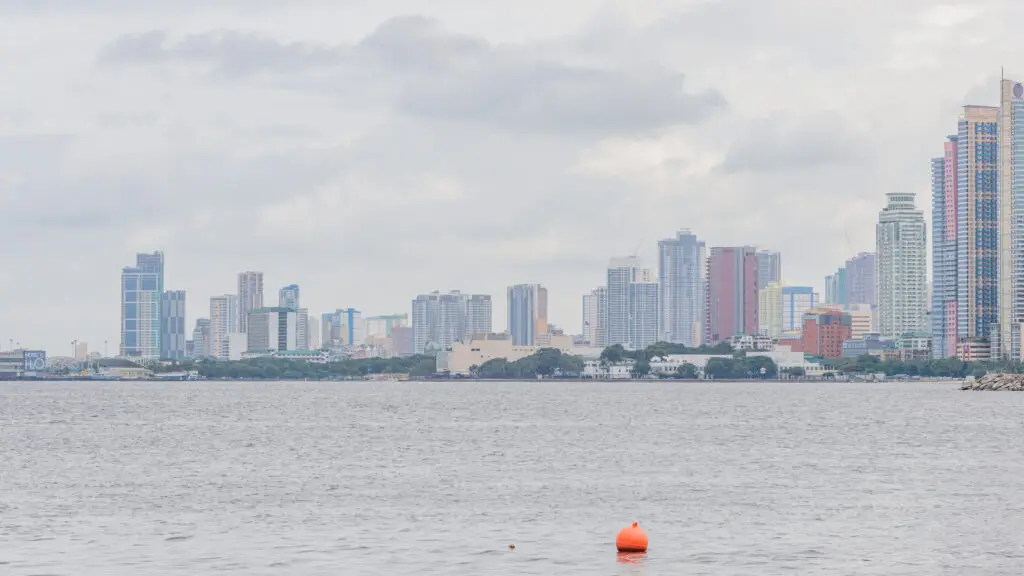
The Philippines is a scattered archipelago of more than 7,000 islands, wrapped on all sides by ocean, drenched by 2,400 millimeters of rainfall every year, and visited by an average of 20 typhoons that turn its streets into rivers. On the surface, this is not a country that should be running out of water.
And yet, the effects of water bankruptcy are already pervasive here.
Back then, the women in communities would travel to the poso to draw water by hand, says Jimenez. Since extraction was manual and unhurried, the aquifer below had time to replenish itself between each draw.
Cut to today, in some areas, electric pumps have replaced the old hand-drawn wells. “Malakas ‘yung sipsip,” Jimenez said, echoing a frustration shared across communities. This means the suction is strong enough to drain the water table faster than nature can refill it.
“Nag-dry up na. Wala na talagang tubig na available. Kahit umulan, hindi pa rin ma-rereplenish.”
This problem is not unique to rural wells. It plays out at a national scale too. Every dry season, headlines about Angat Dam creeping toward critical levels come around as reliably as Christmas. Angat Dam is the primary water source for Metro Manila, supplying millions of Filipino households with water for drinking, cooking, and daily use. The dam sits in a watershed fed by the same rain that supposedly makes the Philippines water-rich, but decades of deforestation have stripped the surrounding land bare. Rainfall that should be slowly absorbed in the ground and channeled into the reservoir now rushes off in floods. What should be a resource becomes a disaster.
Then there’s the water burden on families. When Jimenez asks locals how much they pay for drinking water, the answer is usually about ₱30 for a 20-liter container. A household of five goes through roughly three containers a week. That’s ₱360 a month, more than ₱4,000 a year. For a low-income family, that is a significant, recurring cost. “Vended water has the same price for everyone” she said, “pero mas mabigat siya for low-income families in contrast to those with higher disposable incomes.”
Water, the most fundamental thing a human body needs, is the one commodity that has no alternative if you can’t afford it.
Dr. Kaveh Madani, Director of the UN University Institute for Water, Environment and Health said of water bankruptcy: “Bankruptcy is not the end of action. It is the start of a structured recovery plan: you stop the bleeding, protect essential services, restructure unsustainable claims, and invest in rebuilding.”
In other words: we’re only just beginning.