

June 3, 2026 · Photographer Gab Mejia has always been drawn to bodies of water. In his earlier works, he told stories from places like the Agusan Marshlands in Mindanao, the largest inland wetland in the Philippines, working with indigenous communities like the Manobo.
In his latest project, White Water, he draws from personal memory and experience, as he examines, “the entanglement of memory, colonial maritime cartography, and rising seas across the Philippine archipelago.”
White Water is part of the 2nd edition of FOTO Bali’s International Photography Festival, which runs from June 3 to July 12 at Nuanu Creative City in Bali, Indonesia. Centering on the theme Afterimage, the exhibit brings together 36 artists from 24 countries, presenting works that reflect on images that trace quietly, reject immediacy, and sustain a long, perpetual conversation on places, bodies, communities, or images.
Mejia’s affinity for water may be an inherited instinct: His father is from Orion, Bataan, a town facing Manila Bay, while his mother grew up in Hagonoy, Bulacan, known as a wetland coastal town. Growing up, his dad often took him to visit rivers, wetlands, and lakes from Laguna to Bataan, while his mom would bring him to visit her hometown.
This connection with water eventually followed him into adulthood; he became a diver, surfer, and explorer who traversed the sea many times to follow stories. There was a pull towards water no matter where he went, a pull he describes as “a generational inclination to see water as something part of our lives.”

Yet water has its dark side too, and over the years, Mejia’s family has experienced the impacts of intense rains and flooding as a result of climate change. Rising seawater flooded his mom’s ancestral home in Bulacan, and his grandfather’s tomb had to be relocated to higher ground.
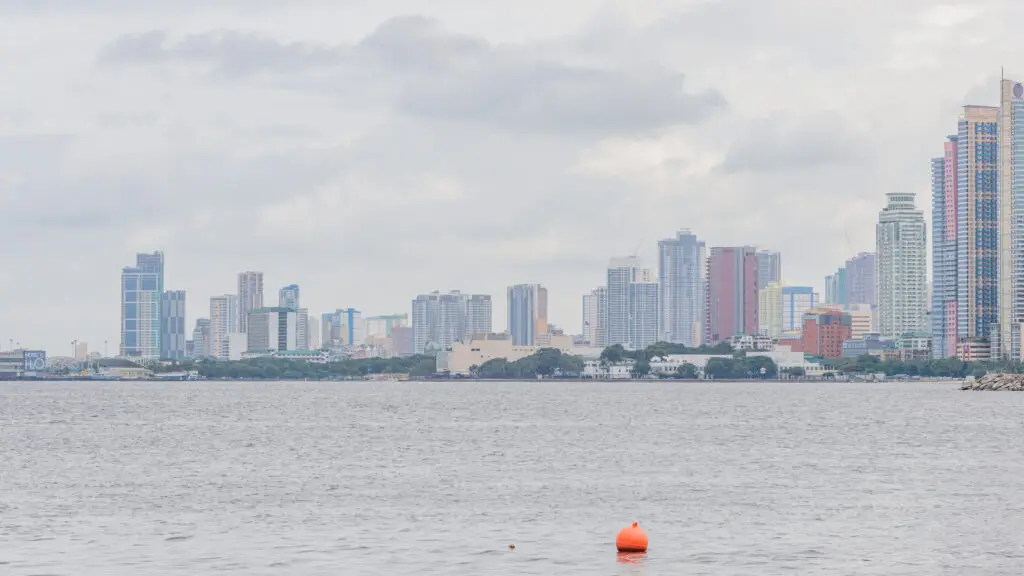
In the Philippines, the mean sea-level rise ranges from 5.7 to 7.0 mm per year, roughly double the global average rate, leaving coastline communities most vulnerable to its effects.
Sea level rise is slow, almost imperceptible, making it difficult to visualize, he said. Hence for Mejia, giving language or visual understanding on climate change has been a constant effort.
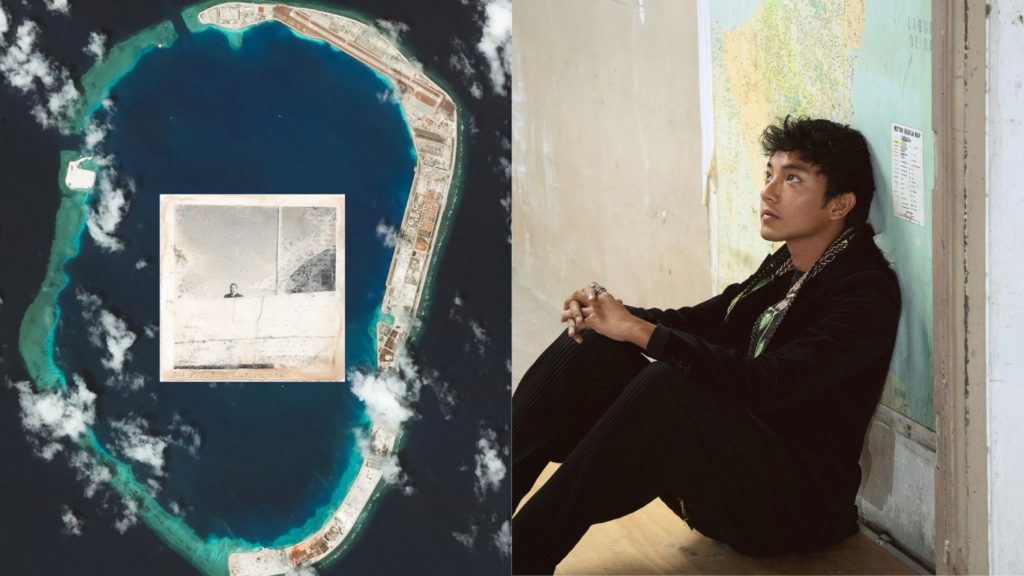
White Water as a concept began as early as 2021, in the wake of the destruction of Typhoon Rai (locally known as Typhoon Odette). When Mejia revisited family photo albums from the 1990s to the early 2000s, he discovered that many of the images had been bleached or smeared—damaged by the floodwaters from Typhoon Ondoy in 2009.
What stayed whole, instead, was the memory that a complete image was once there.
Taking these images gathered from family archives into White Water, Mejia deals with questions about how photographs, as fragments of truth, are transformed by ecological forces—in this case, by water itself. Memories washed away by floods are caught again and settled into the corners of the frame that become private monuments to the past.

Mejia also moves from personal meditations and engages with notions on colonial histories. Archival images are juxtaposed with maritime maps that once served as tools of colonial power. These maps structured trade routes and created borders that strengthened separation and imposed rigid structural orders.
But nature, due to its properties, allows no borders. It serves as the ultimate deconstructionist, undoing boundaries, eroding lines that claim ownership. Similar to the resistance to the idea of permanence in photography, sea level rise also resists human cartography—a form of geographical reclamation.
In the Philippines, environmental defenders, journalists, and researchers risk their lives to tell the truth. It’s not an easy job, says Mejia, but bearing witness is what one must do, “to be able to shift the narratives of our identity, of our ecology, and of our community.”
By saving what remains, the work engages in “afterimage,” showing how images persist and transform over time. In the case of White Water, the changes are brought about by rising sea-levels. Although archival, a sense of ownership ripples through since Mejia appropriates the materials to form his own images. Instead of retaining the meaning, he makes them.
With this, the project becomes a communal act of remembering, preserving fragments of a coast that may disappear or be forgotten. Yet Mejia also accepts that this is a continuous story, engaging with “unresolved histories, altered landscapes, or lived conditions shaped by power, control, resilience and care.”
For Mejia, water is a co-author. It shapes and forms its own story and history. Water here is not a metaphor, but an active force.
When asked what he hopes his work will achieve, Mejia said he hopes that viewers will linger, see things differently, and allow the images to unfold slowly.
White Water is on display at the FOTO Bali’s International Photography Festival from June 3 to July 12, 2026.