





August 4, 2026 · The Aboitiz Foundation launched the CarbonPH Cebu ReforestationLocal Climate & EcologyReforestationThe active replanting and ecological restoration of degraded forest lands. In carbon project development, its financial viability depends on long-term survival rates, native species selection, and the prevention of leakage, moving beyond superficial tree-planting metrics to verifiable ecosystem restoration.Read more in the Glossary → Project on July 12, 2026. This is the Aboitiz Group’s first large-scale, long-term nature-based initiative in partnership with the Department of Environment and Natural ResourcesPH Laws & FrameworksDepartment of Environment and Natural Resources (DENR)The Philippine executive department managing forests, protected areas, mining permits, and pollution control. It is the primary regulatory counterparty for environmental compliance, natural capital valuation, and the issuance of permits governing resource extraction and land-use changes.Read more in the Glossary → (DENR), local government units, and Archeda Japan.
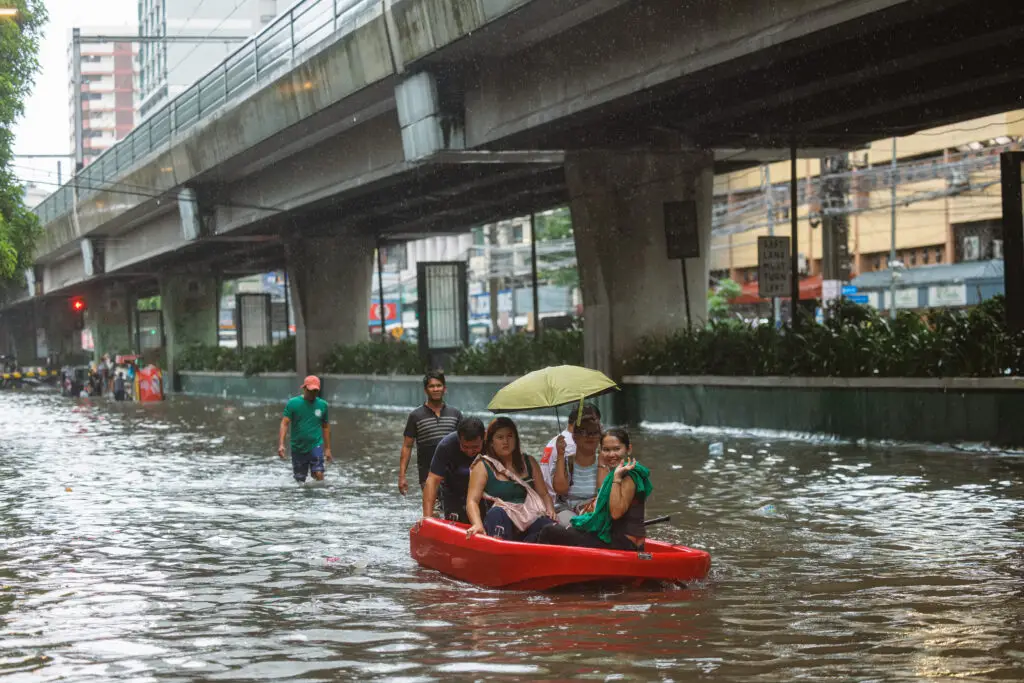
In November 2025, various parts of Cebu were devastated by severe flooding caused by Typhoon Tino, also known internationally as Kalmaegi. The lack of ecological buffer zones—designated, vegetated areas used to separate ecosystems from human activities—exacerbated the effects of the flooding.
Deforestation, caused by commercial infrastructure development, was one of the biggest contributors to the extreme flooding in Cebu. In an assessment of the Monterrazas property that faced backlash for possibly contributing to the heightened flooding, DENR Assistant Regional Director for Technical Services Eddie Llanedo shared that out of 745 trees documented on the property in 2022, only 11 remained (Read: Monterrazas flood study ‘not an Environmental Impact Assessment,’ UP researcher says).
According to the Aboitiz Group, the CarbonPH Cebu Reforestation project was established to bring back greenery across 71,000 hectares and 10 municipalities in Cebu. Additionally, it is expected to “generate broad co-benefits, including watershedLocal Climate & EcologyWatershedThe topographical boundary draining water into a common river system or body of water.Read more in the Glossary → protection [and] flood risk reduction.”
The project involves afforestation, reforestation, and revegetation (ARR) activities, which aim to “establish, increase, or restore vegetative cover.” The project is also expected to improve biodiversityGlobal EssentialsBiodiversityThe variety of life at genetic, species, and ecosystem levels. Biodiversity loss is a material financial risk and a prerequisite for nature-positive investment frameworks.Read more in the Glossary → conservation and agroforestry systems in the targeted area.
In 2024, the Aboitiz Foundation announced its partnership with the Cebu Provincial Government for the reforestation project. Aboitiz Foundation Chairman Sabin Aboitiz signed a Memorandum of Understanding (MOU) with Cebu Governor Gwen Garcia, acting Cebu City Mayor Raymond Alvin Garcia, and Talisay City Vice Mayor Richard Francis Aznar to formalize the agreement.
In a recent interview on Business360, Aboitiz Foundation President Ginggay Hontiveros-Malvar described the foundation’s shift in focus from disaster risk reduction (DRR) to a more sustainable solution.
She shared that through the process of defining themselves as a corporate social responsibility (CSR) entity, the company realized how much climate change affects community development, businesses, schools, education, and agriculture, which led to the creation of CarbonPH.
Towards carbon credit certification
Aboitiz Foundation is working with Japanese climate technology company Archeda Inc. to verify their restorative work. Archeda specializes in using advanced satellite and artificial intelligence (AI) technology, which allows them to enhance the integrity of nature-based carbon projects.
Hontiveroz-Malvar expressed a desire to become carbon credit-certified, a venture made possible through Japan’s Joint Crediting Mechanism (JCM). Carbon creditsGlobal EssentialsCarbon markets & carbon creditsTrading systems where verified greenhouse gas emission reductions or removals are commodified, typically representing one metric tonne of CO2 equivalent.Read more in the Glossary → are generated through nature-based projects to offset carbon emissions and provide financial benefits to project stakeholders, communities, and local governments. (Read: What the Philippines needs to know about carbon markets)
The Joint Crediting Mechanism (JCM) is a system “to cooperate with developing countries for reducing greenhouse gasGlobal EssentialsGreenhouse gases (GHGs)Atmospheric gases (primarily CO2, methane, nitrous oxide) that absorb and emit radiant energy, driving the greenhouse effect.Read more in the Glossary → emissions.” 32 countries, including the Philippines, are currently part of this mechanism. A prominent, ongoing JCM initiative in the Philippines is a joint effort by the Japan International Research Center for Agricultural Sciences (JIRCAS) and the Asian Development Bank (ADB) to reduce methane emissions from rice paddy cultivation.
Though carbon markets provide incentives for nature-based projects, studies warn that emission reductions can be illegitimate and manipulated for financial gain. This also leads to other issues such as green land grabbing, which negatively impacts local communities, indigenous people, and the environment.
According to Archeda Inc., their partnership with Aboitiz Foundation includes feasibility studies, satellite-based environmental assessments, carbon project design, stakeholder engagement, and the development of robust monitoring and verification systems.
Hiromasa Tsumura, CEO of Archeda, commented on the Philippines’ potential in the carbon marketplace.
“We believe the Philippines has the potential to become a leader in high-integrity forest carbon development,” Tsumura added. “By combining innovation, strong governance, and long-term commitment, we hope to create an example that demonstrates how environmental protection and sustainable development can move forward together.”