





September 10, 2026 · Imagine your house is on fire. You call the fire department. They say they’ll send the trucks, but the water won’t flow until someone else signs off, someone in Europe, maybe. You would not stand there watching everything burn.
The Philippines’ newest Nationally Determined ContributionGlobal EssentialsNationally determined contribution (NDC)A country's official climate pledge under the Paris Agreement. The Philippines committed to a 75% emissions reduction by 2030 (72.29% of it conditional on international support) and its second NDC is now overdue.Read more in the Glossary → (NDC) is that fire department.
A Nationally Determined Contribution is the term for a country’s climate plan under the Paris AgreementGlobal EssentialsConference of Parties (COP) & the Paris AgreementThe UN Conference of the Parties and its foundational 2015 treaty, which mandates limiting global temperature rise to well below 2°C, pursuing 1.5°C, and requiring ratcheting national climate pledges.Read more in the Glossary →. It is the document that spells out how much it will cut emissions and by when. Countries are required to submit one every five years.
The Philippines’ updated 2026 NDC says it will cut emissions by 75% for the period 2025 to 2035 against a projected business-as-usual baseline. That is the number on the cover, the number people will write about, and the number that will appear on a slide at the next UN Climate ChangeGlobal EssentialsClimate change/Climate crisisClimate change refers to long-term changes in global temperatures, weather patterns, and the environment resulting from anthropogenic activity such as burning fossil fuels and deforestation. These changes continue to happen…Read more in the Glossary → Conference (COP).
But that 75% is a target for emissions “reduction and/or avoidance” against “cumulative” business-as-usual projections. In United Nations Framework Convention on Climate Change (UNFCCC) accounting, “avoidance” against a cumulative baseline is a well-known shield: it allows a country’s annual emissions to grow in absolute terms, provided the ten-year sum is lower than a fictional hyper-growth scenario.
In the technical annex of the NDC, the tons tell the story.
The baseline assumes the economy grows 7 to 7.5% a year through 2040, which matches the development plan’s aspiration rather than the economy’s history. Against that inflated projection, the unconditional 7% works out to roughly 92 million tons of CO2 equivalent over 11 years. That is under 8.5 million tons a year, from an economy that emitted 287 million tons in 2025 alone, once forests are set aside. The annex also concedes that the 75% figure is “set below the level which has been modeled, to ensure its achievability.”
When you look past the math and find what is actually binding, this is what has been committed: Seven percent of the target is unconditional. Sixty-eight percent exists only if international money arrives.
The document calls this “conditional upon international support,” which is a diplomatic way of saying that nine-tenths of the country’s climate ambition belongs to someone else’s budget and might never materialize.
I have read this text several times now, and what stays with me is not the targets or the sectoral coverage but the hedging.
The implementation of the NDC “is contingent on the availability of accessible, predictable, adequate, and country-driven means of implementation.” Finance must be “highly concessional, non-debt creating.” Article 6 market participation is “voluntary” and “subject to robust national governance arrangements.”
Every commitment has its own precondition. Five pages, and I cannot find a single sentence in which the Philippine government binds itself to a specific, funded, time-bound action on its own authority.
Where does the burden of climate finance fall?
I should put this in context, because the standard argument is that vulnerable developing countries cannot commit without external support, and that is legitimate.
But the ratio matters, and the ratio here is extreme.
Indonesia’s Enhanced NDC commits to 31.89% unconditional by 2030. Indonesia is an archipelago, developing, coal-dependent, typhoon-exposed. Its unconditional-to-conditional ratio is roughly one to one and a third. Vietnam commits to 15.8% unconditional with a conditional ceiling of 43.5%, and it attached a net-zeroGlobal EssentialsNet zeroThe state where anthropogenic greenhouse gas emissions are reduced to the absolute minimum, with any residual emissions permanently removed from the atmosphere.Read more in the Glossary →-by-2050 pledge at COP26. Vietnam is lower-middle-income and faces serious Mekong Delta exposure, with a growing industrial base that runs on cheap energy. Thailand targets 30% to 40% by 2030.
The Philippines commits 7% unconditional against 68% conditional. I don’t know how to read that as anything other than a decision to do the minimum domestically and frame the rest as someone else’s responsibility, and I say that as someone who works in this region and sits across from finance ministries and climate commissions, who understands what the fiscal constraints actually look like.
I do acknowledge why the NDC might have been structured this way. Under the Paris Agreement, developing nations are explicitly permitted to make their targets conditional on foreign finance, and the current NDC cycle is tied directly to the New Collective Quantified Goal on global climate finance. The 68% conditional portion is the Philippines’ formal diplomatic weapon to tell the Global North that heavy decarbonizationGlobal EssentialsDecarbonizationThe systematic reduction and ultimate elimination of anthropogenic greenhouse gas emissions from an economy or corporate value chain.Read more in the Glossary → will only happen if they fulfill their finance pledges. The 7% unconditional slice is simply the existing, financially viable renewable pipeline that requires zero new domestic political capital. The strategy is rational diplomacy.
But utilizing this strategy as a substitute for domestic energy planning is a potentially fatal error, because it tells the domestic market that the transition is optional until foreign funding comes through.

Coal, coal, coal
The text of an NDC is diplomatic real estate. The words a country chooses signal what it will fight for on the global stage. The Philippines has spent years rightfully demanding that wealthy nations pay for climate loss and damageGlobal EssentialsLoss & Damage FundThe climate harms adaptation cannot prevent — and the fund, agreed at COP27 and operationalized at COP28, that pays for them. The Philippines hosts the fund's governing board, making this the most personal line item in climate finance for a typhoon-belt nation.Read more in the Glossary →, and that moral argument is correct.
But the word “coal” does not appear anywhere in the NDC document.
By refusing to name the primary driver of its emissions at home, the Philippines undermines its own leverage when it demands a fossil fuel phase-outPH Laws & FrameworksCoal moratorium & fossil fuel phase-outRegulatory bans on new fossil fuel infrastructure (e.g., greenfield coal plants) and the systematic retirement of existing assets. In energy transition finance, this dictates capital allocation shifts, triggering early retirement mechanisms, just transition financing, and the repricing of fossil-fuel-dependent utility portfolios.Read more in the Glossary → abroad.
The 2026 NDC references the Philippine Energy Plan as the guiding instrument for the energy sector, but it does not summarize what that plan says about new coal capacity or test the plan against its own 7% unconditional target.
Climate adaptation vs. mitigation
The adaptationGlobal EssentialsAdaptation vs. MitigationAdaptation refers to solutions that are reactive to the effects of climate change. This includes strategies such as breeding drought-resilient crops, improving disaster preparedness, and building resilient infrastructure. Mitigation refers…Read more in the Glossary → section is robust, and I want to say that plainly.
The National Adaptation Plan 2023–2050 is a serious, long-horizon plan, and the way it weaves in gender equality, diversity, disability, and social inclusion (GEDSI) principles, indigenous knowledge systems, nature-based solutionsGlobal EssentialsNature-based solutions (NbS)Actions to protect, sustainably manage, and restore natural or modified ecosystems to address societal challenges (e.g., using wetlands for flood control).Read more in the Glossary →, and blue carbonLocal Climate & EcologyBlue carbonCarbon sequestered and stored by coastal and marine ecosystems, primarily mangroves, seagrass meadows, and tidal marshes.Read more in the Glossary → is more specific and more thorough than anything Indonesia or Vietnam has produced. The Philippine Ecosystem and Natural Capital Accounting System (PENCAS) law, which folds ecosystem services and natural capital into national accounting, is a real policy achievement. The people who built this deserve credit. They understand what a signal-number-five typhoon does to a coastal barangay in Eastern Samar, and it shows in the writing.
But adaptation is not a reason to ignore mitigation.
The document says mitigation actions “generate adaptation co-benefits.” Mitigation cannot exist just to serve adaptation. The energy sector is guided by the 2023-2050 Philippine Energy Plan. The annex cites that plan’s renewable share of over 40% of the energy mix by 2030—but a target referenced in an annex does not equate to a commitment in a pledge.
The adaptation plan is excellent. It is also, in this document, functioning as a substitute for energy policy, and that is a very expensive substitution.
The Forestry and Other Land Use (FOLU) problem is worse than it looks. The annex shows FOLU as a net source of emissions through 2020, releasing 461 million tons in 2015 alone. It then flips to function as a sink that carries the entire target: negative 2,296 million tons cumulative over 2025 to 2035. The shift is attributed to cropland shrinking about 1% a year, and continued forest gain. But neither sit inside the climate policy toolbox and the methodology makes no allowance for natural disturbances across the target period. It assumes 11 years in which no typhoon of consequence damages a Philippine forest.
Forest carbon in a typhoon-prone archipelago is volatile. A bad storm season can wipe out hundreds of thousands of hectares. Counting on trees to absorb what the power sector emits is not conservative planning.
Ultimately, adaptation has a ceiling. You cannot adapt to 2.5 degrees of warming with seawalls and crop insurance. The Philippines’ National Adaptation Plan runs to 2050, and if global mitigation fails because every mid-tier emitter shields its commitment behind conditionality language, that plan becomes a description of losses no one can manage. Manila’s long-term resilience depends partly on what Manila does at home. The NDC does not say this.
From where I sit, the Philippines’ 2026 NDC sends a signal that will be read very clearly by the people who control capital. Capital is not blind, and when a sovereign tells the market its climate plan is optional, the market prices that hesitation into the cost of borrowing.
The Luzon and Visayas grids do not run on conditional finance but on long-term power supply contracts and regulatory certainty. The document ignores the machinery the country has already built.
The Philippine private sector, backed by the Asian Development Bank, has already executed the world’s first market-based Energy TransitionGlobal EssentialsEnergy transitionThe structural shift of the global energy system from fossil-based to zero-carbon sources. It encompasses the simultaneous scaling of renewable generation, grid modernization, energy storage, and demand-side management, representing the largest capital reallocation in modern economic history.Read more in the Glossary → Mechanism to retire a coal plant early. The legislature is actively advancing a national emissions trading system, a fact that the annex itself concedes when it notes Congress is considering a compliance market.
These are the domestic mechanisms that attract private capital and force the power sector to clean up. The pledge ignores them, perhaps because acknowledging it would weaken the argument that the Philippines can only act if the world pays first.
The NDC also turns to carbon marketsGlobal EssentialsCarbon markets & carbon creditsTrading systems where verified greenhouse gas emission reductions or removals are commodified, typically representing one metric tonne of CO2 equivalent.Read more in the Glossary → under the Paris Agreement to fund that 68% conditional portion, but under those rules, if you sell your mitigation outcomes as carbon credits to the Global North, those reductions belong to the buyer and cannot be counted toward your own target. This means the 2026 NDC reads not just as a climate pledge, but also as a prospectus.
The annex further lists agriculture, forestry, and industrial processes among the measures “open for international transfers.”
What happens now?
The current report still lacks the detailed implementation plan which would shed light on what exactly the Philippine government is committing to.
What I would hope to see next is straightforward. Raise the unconditional floor to 20 or 25% and model it on the energy transition alone—a coal date and a renewable target. Separate the forestry sink from the headline number, and name coal. Attach the implementation plan that outlines the domestic budget. Fund the just transitionGlobal EssentialsJust transitionA framework ensuring the shift to a low-carbon economy does not disproportionately burden workers and communities dependent on legacy fossil-fuel industries.Read more in the Glossary → as a program with named agencies and named budgets.
Frame the energy shift as energy security, because that is what it is. The Philippines imports the majority of its coal. Every peso spent on imported coal is a peso not spent on domestic geothermal or solar capacity that creates local jobs and stabilizes prices. The 7% should not be framed as a concession to the UNFCCC. It should be framed as the cheapest energy security policy available to the country.
At the risk of being a prophet, the Philippines’ 2026 NDC will pass the UNFCCC review.
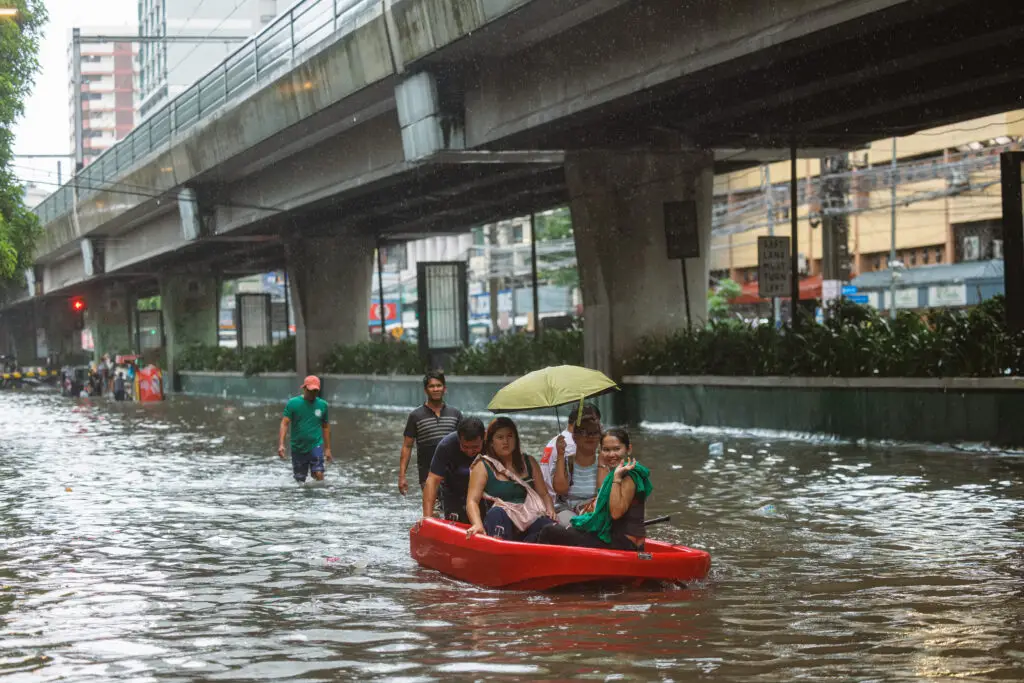
It will be cited at COP side events. Perhaps press releases will call it progressive. And then the next typhoon will cross the archipelago, and the same municipalities will flood, and the same families will rebuild, and this five-page text will sit in a database in Bonn.
Access the updated NDC document here, and the annex here.
Editor’s Note: This commentary was written by Sustina Executive Director Anna Reyes. Comments, responses, or letters can be sent to editor@sustina.earth.