











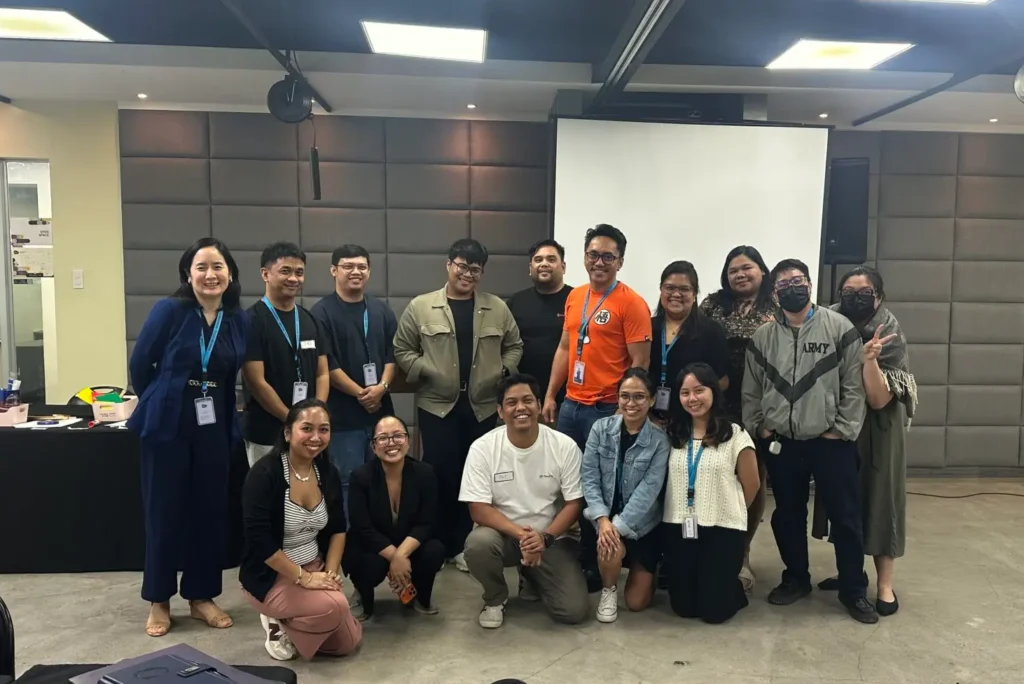
September 22, 2026 · From July 21 to August 4, 2026, Sustina held its second iteration of the Design Thinking Sustainability program and the very first for the AIM-DBI THINCOHORT 2026-2027 Startups. It convened a group of pioneers across disaster-risk reduction management, real estate, agri-fisheries, education, health and human resources.
There exists an idea in many minds that building new products and services is about creating novel and innovative features. That is true, but innovation doesn’t always look as flashy as what it’s often imagined to be. Often, they’re quiet and unnoticeable but always thought-provoking.
Data from the workshop reveal a common thread, illustrating a different face to innovation than what is stereotypical, running through the cohort: adoption resistance is driven by psychological barriers and the most effective way to overcome it is to bridge the trust gap between users and the product or service. Clinging to legacy systems is the same instinct as sticking to familiar routine tasks, the same behavior we’ve observed in users willing to pay a premium for predictability and reliability. They are motivated by retaining psychological safety. User apathy runs on a similar mechanism: what looks like indifference on the surface is burnout and an inability to absorb more change, and risk, within already strained routines.
Once start-ups understand that influencing behavioral change for the goal of adoption is about closing the trust gap, innovation can take the form of designing for clarity, familiarity, and eliminating friction in users’ daily routines. The sooner they recognized this, the higher their success rate in tackling their design challenges went.
Resistance, however, can be structurally harder to solve in some markets. In several cases discovered from the workshop, a user a startup is designing for and the decision-maker who can de-risk adoption are frequently different people entirely. For instance, a teacher or pharmacy cashier isn’t always a person with authority to make operational decisions. Designing for institutional adoption, then, can look more like a tangle of successive activities involving coordinated buy-in across different units, navigating strict guidelines, and complex government procurement cycles.
The cohort now stands at a critical juncture of their journey where what they build and how they design it will be the difference between being just another player in the game and becoming instrumental forces who can change the system.
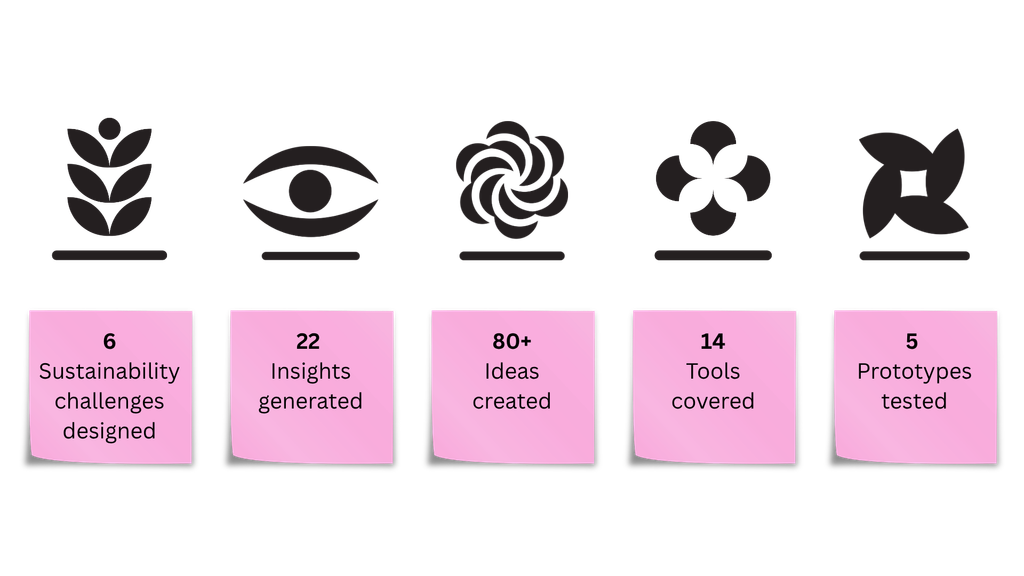
The Journey by the Numbers
Insights
1. The most persistent barrier to adoption across the cohort is the psychological safety of familiar routines.
Users interviewed by the different startups consistently chose known systems over improved processes because switching requires a leap of faith they refuse to make.
This preference for mental ease and risk mitigation overrides the appeal of better outcomes, driving users to accept flawed but predictable daily habits.
Innovations fail when they demand the abandonment of entrenched systems. Adoption requires engineering the new path to feel as safe and automatic as the routines it replaces.
2. Legacy tools persist as emotional trust anchors providing comfort and safety.
Users cling to manual documentation and outdated systems because these mechanisms guarantee stability in unpredictable environments. Treating these workflows as simple inefficiencies ignores their psychological utility.
Successful platforms must design new interfaces around maintaining this exact sense of security and operational support. Adoption requires the new system to replicate the reliability of the old tools while removing their physical friction.
3. Institutional adoption requires designing for layered decision-making because frontline workers cannot authorize change alone.
Teachers and local officials operate inside highly structured, rule-driven systems that strip them of operational autonomy. Standard product rollouts fail by targeting individuals who lack the authority to adopt new tools.
Gaining traction demands securing coordinated buy-in across entire units, navigating strict education guidelines and complex government procurement cycles. Teams must design their solutions around these layered regulatory realities rather than relying on individual user choice, making institutional rollouts inherently more complex than standard product launches.
4. User apathy masks deep operational burnout caused by fundamentally broken and under-resourced support systems.
Teachers and local officials want to do the right thing while navigating environments that actively work against them. Administrative mandates demand extensive learning plans without allocated hours, and disaster response relies on scattered chat logs to track critical data.
Disorganized workflows exhaust the willingness of committed workers over time, producing what looks like indifference. Solutions must repair the underlying operational architecture rather than motivate users who were never the problem.
5. Operational trust drives behavior change where user education fails.
Pitching abstract value or advanced features cannot alter entrenched habits. Startups abandoned user education entirely to guarantee baseline reliability. Teams sacrificed premium branding for supply certainty and replaced complex software with familiar interfaces that provide immediate clarity.
True influence stems from eliminating daily friction to become a stable anchor in a chaotic workflow. Users ignore tools that demand extra attention and rely exclusively on systems that execute predictably.
6. Predictability is the primary product in chaotic environments.
Buyers pay a premium to eliminate daily disruption, choosing exact delivery timing and clear transaction rules over lower costs. Fish farmers prioritize guaranteed stock arrival to protect production cycles.
Homebuyers purchase expert guidance simply to understand basic payment terms. When the baseline environment is unstable, extra features lose all relevance. Market share belongs to companies that engineer absolute reliability and charge directly to remove daily friction.
Email editor@sustina.earth to access the full report.
The Asian Institute of Management-Dado Banatao Incubator (AIM-DBI) is a hybrid DOST-PCIEERD technology business incubator-accelerator that targets innovation-driven entrepreneurs whose businesses have the potential to impact all sectors of society in Asia. We give world-class mentorship from AIM community of faculty and alumni, incubation partners, and networks of founders and industry leaders; a hands-on education and customized training programs to all qualified startups.
Sustina is the National Incubation Partner for Sustainability and Impact of AIM-DBI.