

March 17, 2026 · How does a girl in a landlocked province end up becoming a defender of mangroves?
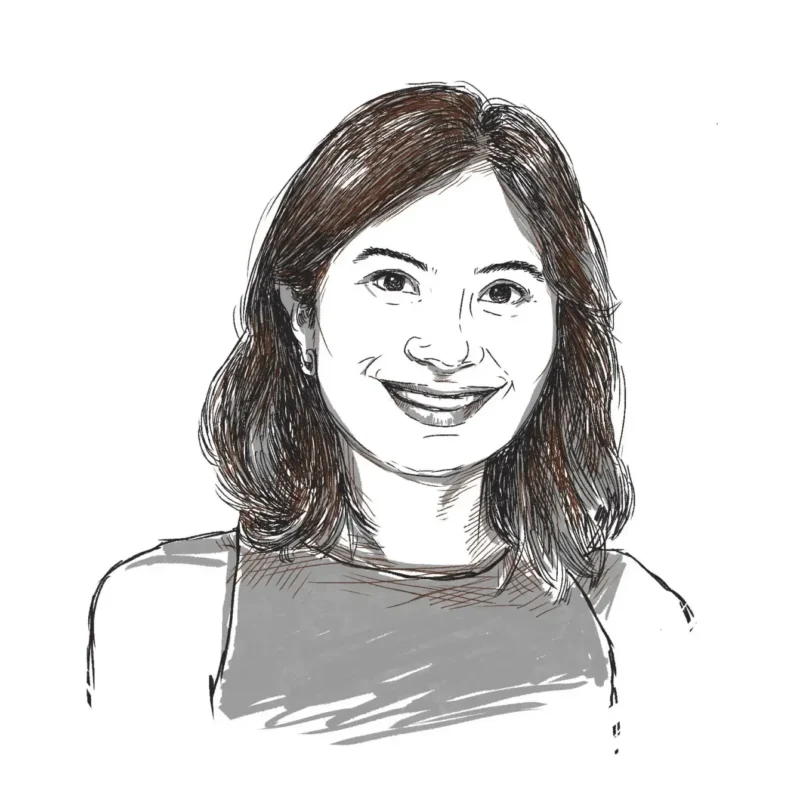
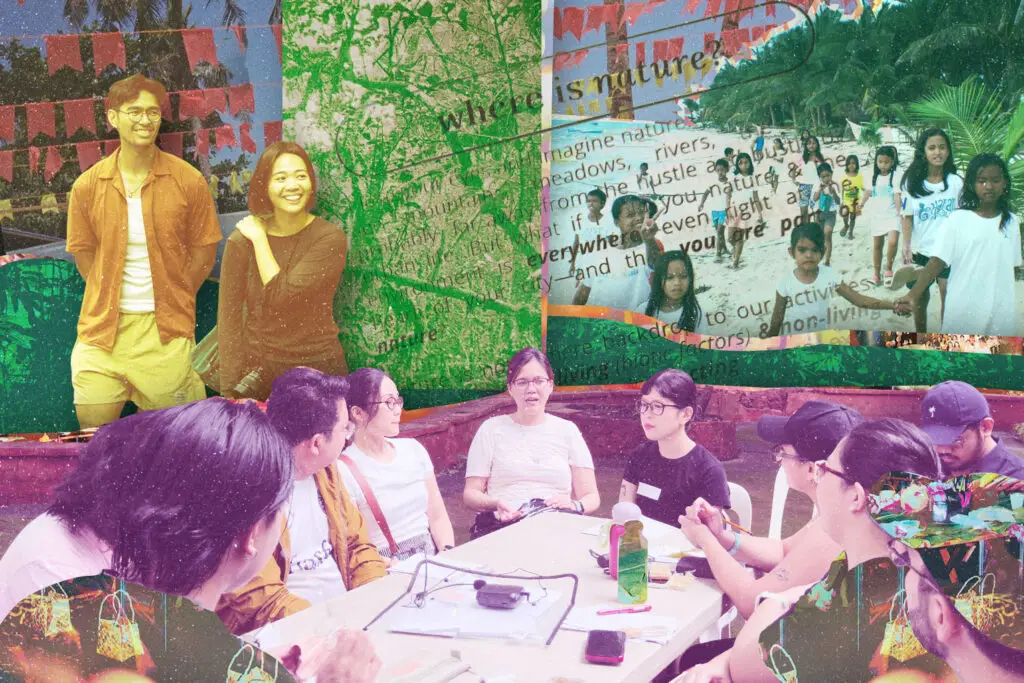
This was the first question I asked Camille Rivera, founder of the local nonprofit Oceanus Conservation. Growing up in Bukidnon, where the nearest coastline was about 100 kilometers away, Rivera had limited exposure to the ocean—apart from a few family trips she fondly remembers as celebrations. This early sense of wonder and curiosity for the ocean eventually led her to pursue a degree in marine biology.
Mangroves, however, came later. While working as a community manager for an NGO in Negros Oriental, Rivera met Evelyn, a community leader whose passion for mangroves opened her eyes to their quiet beauty. Evelyn would walk her through the forest and name each mangrove species in their local tongue, teaching Rivera the knowledge that can never be found in text books. “Because she shared that connection with me, I fell in love with mangroves.”
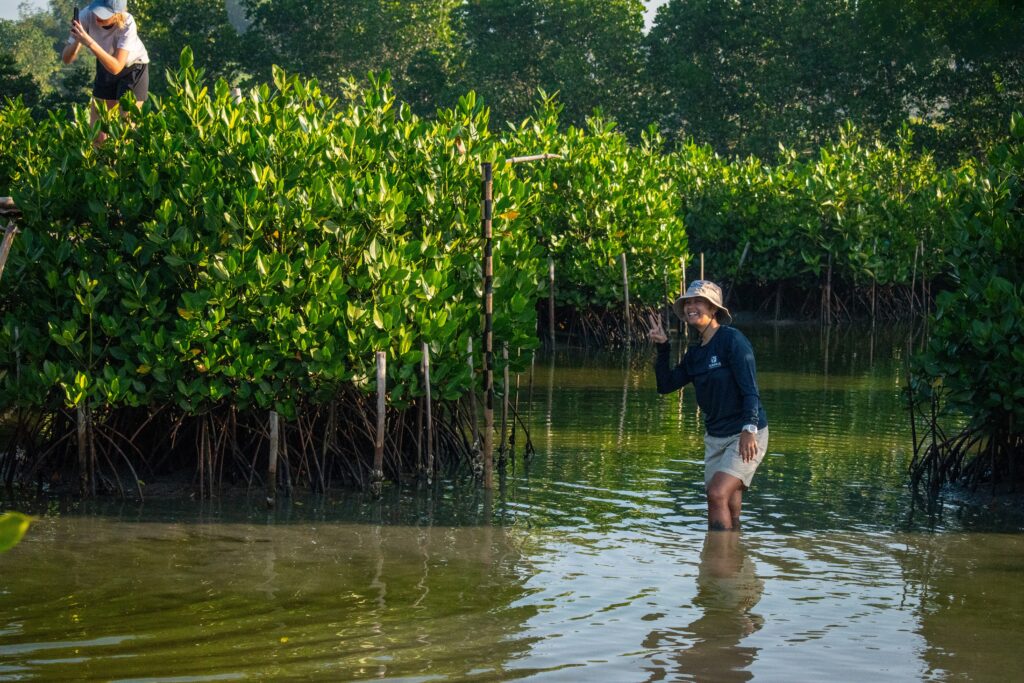
In 2020, Rivera co-founded Oceanus Conservation, a nonprofit that seeks to convert abandoned fishponds into functional mangrove ecosystems. The odds were stacked against her from the start: the Covid-19 pandemic had just hit, funding for environmental work had dried up, and she was a one-woman team. On top of that, she was frequently misjudged for her youth—she was 28 years old at the time—and for advocating for an ecosystem historically overlooked.
As biodiversity loss ranks among the top global risks, champions like Rivera are exactly what the planet needs: people with the empathy to speak for the voiceless and the tenacity to keep going even when the odds seem insurmountable.
Sustina: When you founded Oceanus Conservation in 2021, what were some of the initial challenges you faced in terms of getting stakeholders involved?
Rivera: I started the NGO during a time we actually lost our jobs. The previous NGO I worked with closed down [due to the pandemic]. When we started, the motivation was to gather together so we can bring back the focus to the environment and habitat. But in terms of what would be the topic, I was already trying to solve a problem prior—turning abandoned fish ponds back to functional mangrove forests—and I just wanted it to continue.
In the first year, there was no funding at all. Everyone was focused on health. I have a marine science background, so I also had to navigate not knowing how to open an NGO. During that whole year, the only way to mitigate was [to] involve myself in volunteering work. I volunteered for the Global Landscapes Forum, [where] the main goal is knowledge sharing, but also local action. I was volunteering until at some point, they opened up a Restoration Steward Program. I pitched the project, got in, and was able to get a few funds to start the operations of the organization.
I was 28 when I started the NGO. At that time, as a young conservation leader, I was often underestimated, especially in areas in local government where it’s dominated by senior males or policymakers. It’s very subtle, but there’s a consistent skepticism towards young women, especially as an NGO. I was called out many times. One time they said, “Oh, you’re the founder? You’re so young.” Very subtle. Or I was called “iha” in one of the SB (Sangguniang Bayan) sessions where we were trying to find a way to change some policies, ordinances, and all that. There were many [remarks] that were not just condescending, but even green jokes, sexist jokes.
That sounds terrible. How did you respond to all that bias?
I learned quickly not to put so much personal feeling into it. I tried to just be strong, and try to connect them with data.
I had a mentor from the Global Landscapes Forum who told me, “Look, Camille, when you present yourself, you are a young person, you’re charming. But you need to connect people with data and policy, because that’s what they can connect you with.” So I learned that when I have to talk to the government, I have to learn the Republic Acts or ordinances or local government laws [surrounding] mangroves or the protection of the environment. I’m not a policy person, but I have to learn them [because] it’s the only way to connect with them.
From all those age biases, I learned that the credibility you have in conservation is not tied to years or to titles. It’s always tied to which affiliation you have. It’s a bit hurtful for me because they would only know the big, international NGOs. As someone running a local NGO, that’s where I deal with [bias] in communities. They don’t know the organization as a local NGO. They always refer to us as Oceana, because [it’s what’s familiar].
Speaking of the community, what is their general attitude towards mangroves? Was it challenging to communicate the long-term value of the project?
There are two examples I can give. One in La Union, where they already understand the value of mangroves, so I didn’t have to communicate it. What they lacked was the technique to grow mangroves well [so] we introduced a science-based approach where we raise the soil, and now it has become an eco-tourism site in Aringay. It’s huge, they’re so tall right now, and everyone is so happy.
In Siargao, since it’s facing the Pacific Ocean, [the community’s] attitude towards mangroves is that they feel the protection from storm surges. Very different, right? The one in the north is more for food, because they’re a bit landlocked—I mean, there are waves, but they’re one kilometer away. The other area is more for protection from storms.
When we see those answers in the [Knowledge, Attitude, and Practices] survey, we understand how they connect themselves to mangroves. So when we talk to them, those are the words we use. Some would say, “We get fish in the area.”[…] so we connect with them on how mangroves give them services on a short-term basis, not just long-term.
They already know the benefits, it’s a matter of changing their perspective, especially with abandoned fish ponds. During our whole training, we emphasize that mangroves can bring back the food they need, because [food is important to them].

In biodiversity conservation, bias also occurs towards more charismatic species versus those that aren’t. Outside of the local community, when you talk to funders or other organizations that don’t experience the same connection with mangroves, do you still encounter this bias? How have you overcome it?
Yes, actually, I have. We started [Oceanus Conservation] because of that undervalued ecosystem. When I was doing research to start the NGO, I was thinking about what ecosystem or charismatic species to start with. I did not focus purely on mangroves at first, because I knew it might be difficult for me. I did an NGO mapping of the whole Philippines, seeing who’s doing what. I realized that almost all of them are focused on a charismatic species. And I was like, “Oh, this is a big problem, because without a habitat, no animal can survive.” It’s the same [for] us: if we lose our homes, our houses, everything, we would have a hard time surviving. Either we migrate, die, or adjust.
That was one motivation for me: I wanted to give a voice to the voiceless. These are the ecosystems. And it’s not just mangroves [that Oceanus Conservation] protects; it’s also seagrass. Back in college, I started with seagrass and seaweed, like algae. Mangroves only came during my NGO work. Looking back now, it all came together. All of this work actually comes from my experience in the academe and from [my] previous NGO.
I wanted to give a voice to these undervalued ecosystems that are not highly fundable.
The way I narrate it to donors is: “Look, I’ve seen a lot of organizations focus on charismatic species. But did you know that habitat loss is such a big problem in the Philippines?” I pitched the high loss of habitat in the Philippines for mangroves and seagrass.
At first, I was not given funding. I’m telling you, in 2021, it was like, “Oh my God, there’s no funding for this.” I reached out to big international donors; I only have one Philippine donor, everything else is international. I pitched the whole thing, and they would say, “Oh Camille, we don’t have a focus on oceans, or we don’t have a focus on blue carbon habitats.” I’ve had many rejections.
Then, in 2022, everything moved towards blue carbon because of carbon credits. It pushed that forward. The foundations I pitched to in 2021 went back to me and said, “Okay, we’re ready to fund you.” So it was perfect timing. We had already started our work, so for the last three years, they’ve seen the work we’ve done. The moment they fund, they can attest that we’ve done our programs and strategies well.
It is a bit difficult to push for habitats and push the narrative that we need them. We’re still struggling with that now. But we’re slowly introducing wildlife [in our work], just because it is all interconnected. We have a new project in Surigao del Sur, which is the dugong and seagrass project, so that’s the expanded version we’re working on now.
What do you think needs to change to get more people to care about undervalued ecosystems and species?
Honestly, I don’t know. I wasn’t in love with mangroves back when I was doing research, but what changed from my side [was seeing] the passion of the communities I worked with. I fell in love with the healthy ecosystem I saw, and then I went to an area where it was so degraded. I think for people to actually take care of the environment, they have to see the bad thing and the healthy thing at the same time, and they need to see the communities that rely on these ecosystems.
Seeing the healthy habitat and the degraded one, that’s the only way I felt the connection to pursue what I’m doing now. And I think that’s the only way for people to have more empathy. “Empathy” has always been my go-to word when it comes to the environment. Have empathy that other species rely on this ecosystem too, not just humans. Every time I share stories, I talk about the animals I’ve seen die just because of what we’re doing to the environment.
We live in a world where we’re not the only ones [that exist]. I think that has been lost by a lot of people; they always think, “Humans lang naman dito sa mundo.” You don’t see how all the communities I work with are connected to nature. They will tell me stories like, “Ma’am, that bird… I haven’t seen that for a while.” That’s kind of scary, right? It’s disappearing in nature [and] they already see it.
The communities, they’re very empathetic. It’s the people who have power, the decision-makers. They need to go on the ground more. They need to see what’s happening. I think that’s the only way to change the whole system.

Was there a pivotal moment in your career, or in your life in general, that made you want to be someone who champions the voiceless?
I think I’m super exposed to—I don’t know if you’ve watched The Cove. I think that was the moment where I said, “I’m gonna save them.”
Is it a documentary?
It’s a documentary about dolphins in Japan, where they put them in a cove and the Japanese kill them. I’m going crazy telling this story, but they separate [the calf and mom, and] kill the ones they don’t want for dolphin meat. The others they sell to oceanariums. It was a whole documentary where they even put sounds underwater so you could hear the [dolphins] cry. I’m getting goosebumps; it was heartbreaking. I’m telling you, you’re gonna cry if you watch it.
That’s when I realized I’m on the correct path. I want to protect the animals that are voiceless against humans who are so extractive, capitalist, and all that. And it’s not just about animals, right? I connected it to habitats, because we still need to protect where they live.
When you protect a habitat, the animals actually come back. It’s systems thinking: how can we protect the animals if we don’t protect the only habitat they live?
Speaking of giving a voice to the voiceless… if mangroves could talk, what message do you think they have for us today?
You know, we did a love letter to mangroves recently. We have a post on Instagram in Oceanus for wetlands. I think if they could talk, that’s scary. I feel like they’re gonna say, “You destroyed us!”
But I want to go with hope, at least. And the hope is, I feel like they would say, “We’ve done so much for you. We’ve protected the shore for the communities. We’ve protected you. I hope you can protect us back.”
This interview has been edited for length and clarity.