




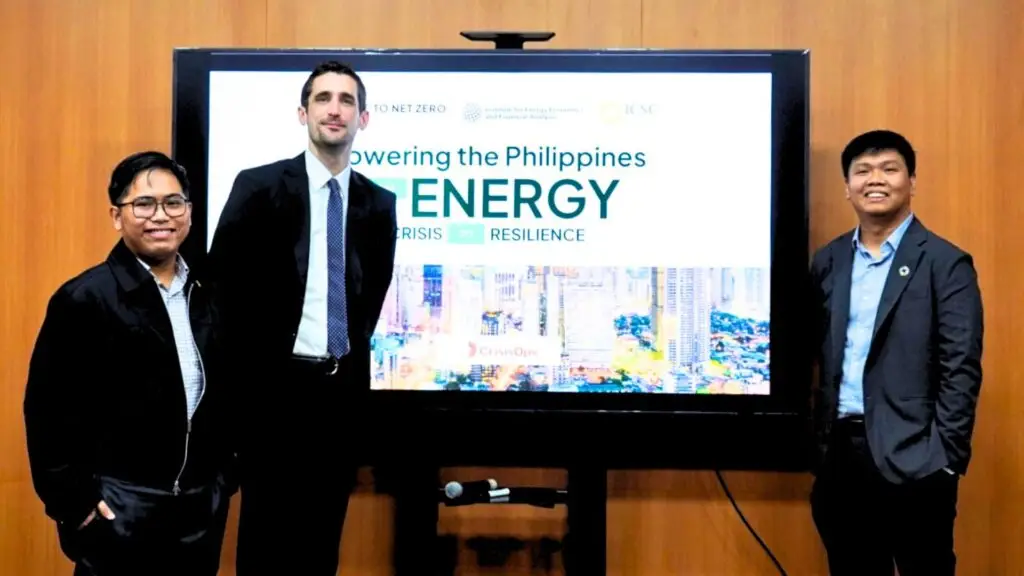
November 4, 2026 · The Philippines’ electricity rates remain among the highest in Southeast Asia, and was briefly the highest in June 2026. This was a recurring fact in the presentations at Race to Net ZeroGlobal EssentialsNet zeroThe state where anthropogenic greenhouse gas emissions are reduced to the absolute minimum, with any residual emissions permanently removed from the atmosphere.Read more in the Glossary → Philippines’ October 21 public policy forum, “Powering the Philippines from Energy Crisis to Energy Resilience,” organized with the Institute for Energy Economics and Financial Analysis, and the Institute for Climate and Sustainable Cities (ICSC).
Held at the Asian Institute of Management, the forum brought together regulators, decision-makers, and finance leaders in an engaging discussion about what it means to be an energy-resilient country.
The Philippines’ high electricity rates are largely attributed to generation chargesGlobal EssentialsGeneration ChargesThe cost of actual generation from power plants, added to the pass-through cost from distribution utilities like Meralco. Prices fluctuate according to fuel prices, foreign exchange rates, and supply and demand.Read more in the Glossary →, noted Jephraim Manansala, Chief Data Scientist at ICSC, using Meralco’s residential rate as an example. Meralco is the country’s largest distribution utility, serving Metro Manila and nearby provinces.
A July 2026 Meralco bill breaks household charges into generation charges (62.38%), taxes (10.18%), distribution (9.33%), and transmission (8.62%).
Only distribution charges go to Meralco, while everything else compensates the “pass-through” cost of distributing power from suppliers, or energy generators.
This means that generation costs are entirely paid for by the consumers.
The cost of generation is largely dictated by Power Supply Agreements (PSAs), or direct contracts with generators for agreed prices and terms, and the Wholesale Electricity Spot Market (WESM), a centralized market where electricity is traded in real-time. When energy supply is tight, WESM prices are volatile and prone to sudden spikes.
Because spot prices swing so sharply, Meralco buys only 2.1% of its power from WESM. Compared to distributors in Visayas and Mindanao that depend over 40% of their supply on the Wholesale Electricity Spot Market, this results in Meralco’s average price being PHP 2-3 higher than its regional counterparts.
Manansala noted Mindanao’s WESM strategy produced cheaper electricity rates, in contrast to Luzon’s reliance on long-term coal contracts from foreign suppliers. WESM’s volatile pricing deters distributors like Meralco—forced outages, peak demand, and transmission constraints can spike WESM rates, resulting in higher bills for households—hence its strategy to lean towards the steadier pricing of PSAs. However, its long-term contracts have also fallen victim to international fuel prices and foreign exchange rates fluctuations. This has resulted in higher rates than distributors that buy more from WESM in recent months.
“Heavy reliance on imported energy makes the Philippines highly vulnerable to global supply chain disruptions, while fuel price increases are passed straight to consumer bills,” stressed Manansala.
Gas is losing ground in the Philippines as solar and storage get cheaper
“In the Philippine power mix, coal remains king,” started Sam Reynolds, Research Lead for LNG/Gas, Asia at the Institute for Energy Economics and Financial Analysis.
The steep fall of the share of gas, he explained, is a trend seen across Asia due to “falling domestic production and cheaper alternatives.”
LNG, or Liquefied Natural Gas, is used globally as a “transition fuel.” As countries build their facilities and capacity for renewable energyGlobal EssentialsRenewable energyEnergy derived from naturally replenishing sources (solar, wind, geothermal, hydro).Read more in the Glossary →, LNG provides power with lower emissions compared to coal—thus its vital role in energy transitionGlobal EssentialsEnergy transitionThe structural shift of the global energy system from fossil-based to zero-carbon sources. It encompasses the simultaneous scaling of renewable generation, grid modernization, energy storage, and demand-side management, representing the largest capital reallocation in modern economic history.Read more in the Glossary →.
Reynolds noted that in the Philippines, new gas plants have been slow to build with the EERI Batangas plant, the first in nearly a decade. Although it opened in 2025, no other gas projects have progressed beyond early stage development due to high building costs. Meanwhile, solar and wind capacity has gone up.
“The price to recoup just the operating costs of your existing plant, and just operating gas plants, is more expensive than building new solar and storage plants. That’s a critical threshold for the economics of renewable energyPH Laws & FrameworksRenewable Energy Act of 2008 (RA 9513)Enacted in 2008 to accelerate the exploration and development of renewable energy in the Philippines to reduce reliance on fossil fuels. These renewable energy sources include, but are not limited…Read more in the Glossary →—and these are not theoretical prices. These are the prices awarded in [the Philippines’] fourth green energy auction,” he said.
Despite declining coal production in 2025, Reynolds highlighted that 109 coal contracts were signed in the past two years alone. “This shows the continued reliance on coal power, even as renewable energy grows. The result is a system with expanding clean energy, but coal getting further embedded,” his presentation read.
He further argues that due to the sharp decline of domestic gas production, the Philippines is left exposed to the LNG markets. While the Philippines’ LNG supply is not directly affected by the ongoing conflict in the Middle East, it is supplied by traders like Shell, Vitol, and JERA.
The Philippines’ lack of PSAs with these suppliers makes it heavily exposed to spot market LNG prices, which have tripled since the start of the ME conflict, according to Reynolds, and is predicted to remain high through 2028 as markets have begun to “price in a longer-term conflict.”
Returns on LNG may not justify the cost
A recurring message from the forum’s presentations is that the Philippines’ dependence on imported energy is a result of its low domestic coal and gas production.
Gas facilities remain few due to its high costs, hence the uptake of renewable energy investments.
Ceejay Hernandez, Head of SustainabilityGlobal EssentialsSustainabilitySustainability is the ability to manage and use resources to meet present needs without compromising future generations. It can be examined through environmental, economic, or societal lenses. These are the…Read more in the Glossary → at HSBC Philippines, underlined that with the current pricing of LNG facilities—which are, essentially, for transition only and should be phased out for renewable energy in the near future—the return on investment for financial institutions to invest in it is hard to justify. “If you want [an] LNG plant by 2030, you should have ordered two years ago,” he stressed.
There is also the question of when this transition fuel will be phased out and how will LNG plants be transitioned down the line. Singapore, for example, requires new and repowered plants must be at least 30% hydrogen-compatible and able to be retrofitted to run fully on hydrogen in the future.
This policy and timeline is not yet available in the Philippines.
“So the question now becomes, when do you transition? If you transition in 25 years what is the ROI calculation? Does it make sense?” Hernandez added.
“Transition requirements tend to have a very narrow lifespan vs ROI for new LNG plants, which puts transition plans as long term key revenue drivers.”
He stressed that the growing demand for digital infrastructure and data centers is driving investments in renewable energy due to clean energy requirements.
A notable example is the proposed Pax Silica hub, a 1,620-hectare manufacturing hub in New Clark City, Tarlac which is designed to support the supply chain for artificial intelligence, semiconductors, and mineral processing. At full development, the project is expected to require 3 to 5 gigawatts (GW) of electricity.
According to a policy brief by the Center for Environmental Concerns – Philippines (CEC), the project would consume 20% of the Philippines’ current annual electricity consumption just at its minimum requirement of 3 GW. (Read: Why is the Philippines offering the US-led Pax Silica 4,000 acres of land?)