







November 24, 2025 · Cristian Lucañas notices things regular people don’t. In 2016, while conducting fieldwork in a limestone cave on Polillo Island, Quezon, he observed small insects crawling atop a pile of bat droppings. Instead of stepping away, he brought them up close—these weren’t just insects, they were cockroaches. The Philippines’ favorite pest.
But they didn’t look like the ones back home. They were small, around 2.5 mm in length, about the width of a regular toothpick. He pointed them out to his thesis advisor, who brought him on the trip, and asked if he knew what type of cockroach it was. An entomologist whose work revolved around scale insects, the advisor shrugged and said he did not know.
“That’s what sparked my initial curiosity,” Lucañas said. Later on, he finds that not many Filipino scientists are particularly interested in studying cockroaches, so he decides to take on the challenge. “Noong nagsimula yun, wala na, tuloy-tuloy na.”
This particular cockroach was a new species of Nocticolidae—a genera of cockroaches that dwell inside caves and lack certain metabolic characteristics, making them worlds different from your regular household pest. This discovery marked the beginning of an unconventional adventure for the young scientist who, to date, is the only roach expert in the Philippines.

Globally, there are about 3,500-4,000 known species of cockroaches, a number that is too small even in the field of entomology. In the Philippines, there are 130 species of cockroaches, and only five of those belong to the common household pest group. Of this number, Lucañas has described 7 new species and 4 genera.
Some of them, he named after important figures in Philippine entomology, like Nocticola gonzalezi named after the former director of UP Los Baños Museum of Natural History, Juan Carlos T. Gonzalez. Others, he named in honor of the fantasy worlds he loved: two cockroach generas inspired by characters from The Lord of the Rings, and another Nocticola species named after the Pokémon Pheromosa.
Why are humans so disgusted by cockroaches? One hypothesis centers on evolution: these insects often indicate unsanitary conditions, contamination, or potential disease risks, so avoiding them would have helped protect early humans from illness. They are not exactly the most physically attractive creatures either: they have sharp and hairy legs, beady eyes, and a foul stench resulting from their natural gut bacteria.
But like Lucañas, there are other defenders of the ipis out there.
“Our hatred for roaches is a delusional and destructive detachment from nature,” said Brent Karner, a former curator of entomology at the Los Angeles Natural History Museum, in a 2015 article for The New Yorker. Among scientists, one hypothesis in defense of cockroaches highlights their role as poop cleaners in ancient caves where animals like bats and ancient humans used to live.
The cockroach’s repulsive traits aren’t accidental byproducts of nature—they are, in fact, the very qualities that make cockroaches good.
As detritivores, they can break down large, organic matter into smaller pieces that can easily be accessible by microorganisms like fungi and bacteria, and their bodies have a built-in mechanism that allows them to recycle nitrogen, which then returns to the soil through fecal matter. “Cockroaches help in hastening the decomposition process, para mas maging available yung nutrients sa soil at madali silang ma-absorb ng ating plants,” Lucañas explained.
In short? We need them.

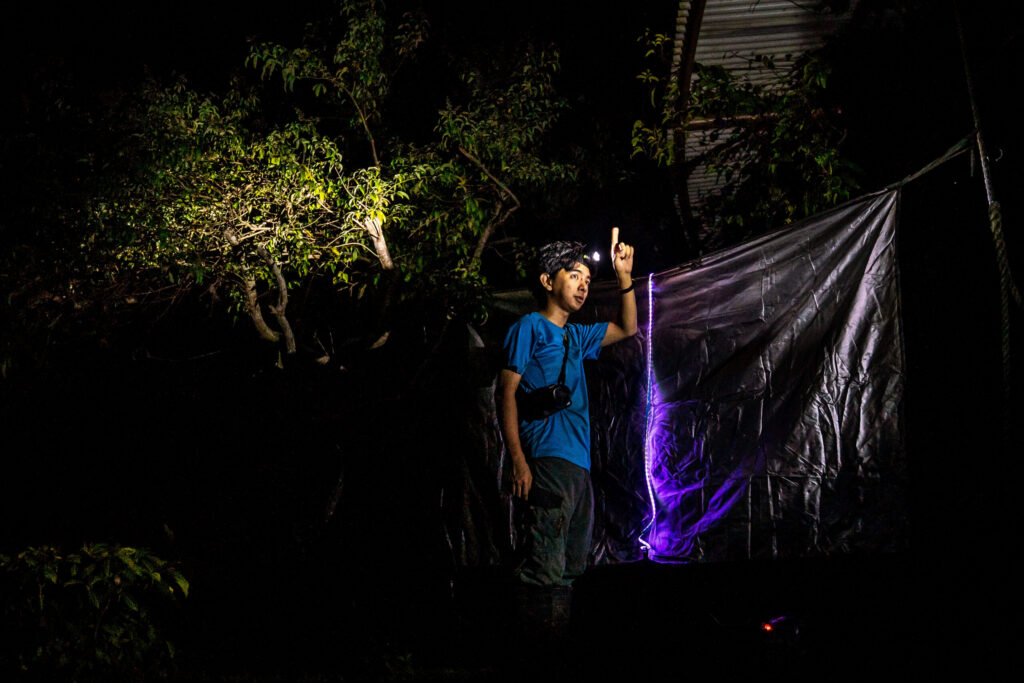
Earlier this year, Lucañas’ sharp observation skills were put to the test during a biodiversity field survey at the award-winning conservation site Masungi Georeserve, located in Baras, Rizal.
Happening several times a year, these research expeditions provide valuable data on the health of the forest’s ecosystem. “They tell us what species are returning as the forest regenerates, and how we can protect them better,” Ann Dumaliang, co-founder and managing trustee of Masungi Georeserve, said.
During this trip, Lucañas noticed an unfamiliar black bug sneaking around forest leaf litter near Masungi’s garden cottages. Slightly large and oval-shaped, it turned out to be a small-winged cockroach that bore physical similarities with a specimen he first collected in Mt. Makiling in 2017. After comparing it with the insect samples they had back at the UP Los Baños Museum of Natural History, mostly collected from caves in provinces around Southern Luzon, Lucañas realized he had been misdiagnosing the genus all along. “I have around four or five other new species under that genus, so that’s what I’m working on now,” he said.
These expeditions are not just data collection points, but also “moments of rediscovery”—as Dumaliang put it—both of the land and people’s relationship with nature.
When people start looking at natural landscapes not just as scenery but a living community of beings, they begin to care for it as kin. It is a journey that finds its footing thanks to the curiosity and tenacity of scientists like Lucañas, who would spend their days kneeling quietly by patches of leaves, turning over a rock, or listening closely to sounds the rest of the world often overlooks.
“With scientists, a simple one-hour walk can easily become a four-hour journey, because even the smallest worlds demand attention. A single patch of mossy rock in Masungi is already an ecosystem of its own,” Dumaliang said.
In many ways, Lucañas is a detective: collecting evidence of insect life throughout his travels and bringing them back to his lab—each specimen a potential puzzle piece in the map he’s building of roaches in the Philippines.
But he did not always start out that way. Growing up, Lucañas only knew of the regular household cockroach, Periplaneta americana—and he too found them repulsive. “When I was in high school, I saw an episode on National Geographic of Japanese researchers studying cockroaches… sabi ko sa sarili ko noon, kahit anong mangyari, hindi ako mag-aaral ng ipis.”
But what initially felt like a “curse” has turned into his life’s work; one he has steadily applied himself to, despite the raised eyebrows and questions that come with choosing to study one of the world’s most reviled insect groups. Even globally, the number of entomologists that specialize in roaches is very small, but the warmth and collaboration he experienced when he first entered the space was what encouraged him to stay.

“Madami pang mga un-described insect species sa Pilipinas […] pero usually [sa] isang family lang naka-focus. Ang problema ay hindi ganoon ka supported in terms of funding [ang insect biodiversity research]. The mindset is more industry-oriented.” He hopes to change this stigma slowly through his work, and dreams of building a localized website for all insect groups in the Philippines to equip future researchers and entomologists.
After nearly a decade of doing this type of work, Lucañas no longer thinks that cockroaches are gross: “Minsan, kinakawayan ko pa sila kapag nakakasalubong sa daan,” he wrote to me jokingly. Still, he wouldn’t have them anywhere near his living room.
“In biodiversity groups, we always say, ‘We have to study [these insects] before they go extinct,’” Cristian said. “Bago man lang silang mawala, ma-recognize natin na merong nag-exist, or nag-eexist ‘yung mga organisms na ‘to. It’s the least that we could do.”