

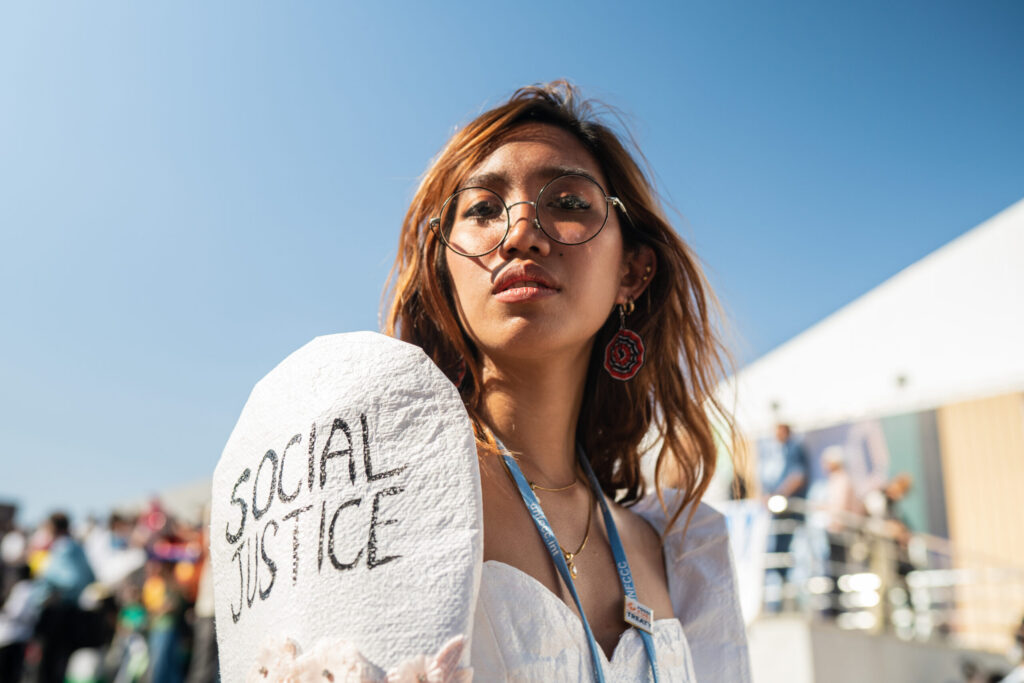
September 17, 2025 · Growing up in the 2000s, Mitzi Jonelle Tan witnessed the effects of the climate crisisGlobal EssentialsClimate change/Climate crisisClimate change refers to long-term changes in global temperatures, weather patterns, and the environment resulting from anthropogenic activity such as burning fossil fuels and deforestation. These changes continue to happen…Read more in the Glossary → firsthand. The words “climate crisis” barely existed back then, but the rains that pounded on roofs and the winds that felled trees and billboards were as real as the people who emerged from their homes in the aftermath, shaken by what they had just survived.
“My mom tells me I would cry whenever I saw a fallen tree after a typhoon, but that’s because I’m actually really bad with directions,” she shares. The trees outside their house were Tan’s guideposts, a way of knowing when home was nearby. “So when the trees fell, I felt lost, like I didn’t know where I was anymore.”
Long before she became a prominent youth climate activist, Tan had always held the natural world close to her heart. As a child, she wrote poems that reflected this love; writings that, thankfully, her mother had kept. “When the wind passes through my hair, I am a bird flying,” she recites. “When the wind passes through my hair, I am a deer running. And when the wind passes through my hair, I am just me.” While seeds of this love had been planted early on, it wasn’t until her final year in university that Tan decided to set off on the path of full-time activism.
She spoke to a Lumad leader then, during the annual indigenous people’s march at UP Diliman. “He told me how they were being harassed, displaced, militarized, and killed for protecting the planet… and then he shrugged. ‘That’s why you have no choice but to fight back,’ he said. And then he asked me about lunch.”
The encounter opened Tan’s eyes to the realities of the environmental crisis. “Here I was thinking I had the privilege of choice. And even if I did have that privilege, why would I not use it to fight alongside the most marginalized?”
Since 2018, Tan has become one of the leading voices in the global climate space, representing Filipino youth climate activists from conferences in Egypt to rallies in New York. She is also the convenor of Youth Advocates for Climate Action Philippines (YACAP), the biggest nationwide youth alliance for climate justiceGlobal EssentialsClimate justiceA framework approaching climate change as a systemic equity issue, asserting that populations contributing least to historical emissions bear the disproportionate burden of climate impactsRead more in the Glossary → and urgent climate action.
Tan is now based in Berlin, taking up her Master’s program in Intercultural Conflict Management at the Alice Salomon Hochschule. When asked how she feels about leaving the Philippines, she likens it to feeling lost; like when the typhoons uprooted the trees near their house. Overseas, she will have to look harder to find traces of home—though with a global Filipino diaspora, it may not be as difficult to find. But moving abroad also comes with the risk of losing the language of her tongue and her mother, a language that has shaped not only the way she thinks but the way she sees the world and expresses herself in it.
A day before her flight, Team Sustina had the honor of sitting down with Tan to reflect on the current state of climate justice in the Philippines; her approach and journey toward climate activism; the tension of holding both love and anger in this space; and what she’s looking forward to as she embarks on a new chapter.
Sustina: You talk a lot about how much you love the Philippines—both online and in your writing. How are you feeling now about living in a different place? What are the feelings that come with that?
Tan: When I was younger, [people] were already saying, “Oh, you should go abroad, that’s where you should study.” As a kid, I was like, “No, I’m never leaving the Philippines. I love the people. I love the land here.” This was before activism; this was just me as a kid.
If that kid got to meet me now, [I think] she’d be like, “What’s happening?” “Do you not love the Philippines anymore?” There’s a certain guilt that comes with [moving away]. Realistically, I do enjoy my experiences outside our country. With my work, I’ve been able to experience green spaces, parks, walkable sidewalks, [and] public transport. And it’s so unfair that we do not get that in the Philippines; not because it’s our fault, not because we’re meant to be a poor country, but because it was intentionally done to us so that we are dependent. That guilt of being able to experience this and enjoy it, and feeling like I’m leaving a part of me behind [when I leave] … It’s like feeling lost again and not knowing where I’m going and not knowing what’s to come.
Having lived abroad ourselves, we are very familiar with feeling almost guilty that you get to experience this when other people don’t. It’s such a complicated feeling. I’m curious to know how that dissonance shows up for you as an activist, whose work is so deeply entwined with how you convey your message. Do you feel like your language of home is going to evolve when you move?
Yeah, definitely. I mean, a part of it has already changed… When I joined the international youth climate movement, I feel like little pieces of my heart have been left with the people I’ve met. So in a way, my heart is always broken, [but] my heart is also everywhere. My home is everywhere. And I think that’s going to spread even more when the biggest part of my heart is now so far away from me.
But I also think [moving away] is such a Filipino experience. I was reading this book recently called “Ausländer,” which means foreigner in German. It’s written by a Filipino migrant. A quote in it says, “Being a migrant is a Filipino experience at this point.” I think [this experience] is going to open me up to a whole different part of being Filipino, but I don’t know what it looks like. I’m scared, but I think it will help me understand our country more when so many of our people are overseas.
When we think of the word “activism,” it often sounds hard and unrelenting, almost like a dichotomy. But a lot of the words you use in your activism revolve around the idea of love. Is that purposeful? Is that how you viewed things ever since you were a child?
I think there’s always been a lot of heart, but coming into my activism, my political education was very [rigid]. [But] actually in the marginalized communities I’ve been visiting, one of the first things they ever told me was, “Mahal ka ng masa.” “Kinukupkop ka ng masa.” That even if no one else will accept you, the masses will love you.
There is a part of activism where the calling out can [easily] turn into cancel culture. But the more you go into marginalized communities, the more accepting they are. The more they’re like, you know, anyone who wants to come and listen, we will embrace fully.
Growing up, my mom also did this thing… as long as I’m talking, they listen to me. I always felt like my voice was meant to be heard. So when my voice wasn’t being heard, the thought process isn’t, “something’s wrong with me,” but “oh, something’s wrong with the system.”
I think the love messaging also started coming out [during] a time when I was getting really burnt out. In the beginning of my younger activism days, there was a lot of anger fueling me. Then I [realized], I don’t wanna be angry all the time. What is this actually about? This is me caring. And now, it has switched to: my anger is love.
It’s been this journey of accepting all parts and manifestations of the [emotions] I’m feeling and realizing that… even when I’m afraid of something, it’s because I care and want to make it right. If I’m angry at something, it’s because I love and I don’t want that to happen to what I love.
How did you get to the point where you realized you could hold both love and anger at the same time?
I think it was embodying the experience of surfing, where I’m literally having to balance on a wave. Sometimes there are angry waves, but the angriest are the most fun, because they’re the bigger ones. There’s this quote: “You’re not the wave that’s angry, you’re not the wave that’s calm, you’re the ocean.” Realizing that it’s all a part of you [is], I think, the reason why I’m able to see my anger as love, because I’ve stopped telling it to not be angry. If I’m angry, I’m like sige, go be angry, because you love this. You need to yell because you love this. And suddenly my anger feels a little bit more listened to, and then she’s like, “Oh, maybe I don’t need to be so loud ’cause you already heard me.”
Let’s do this in practice: What has gotten you angry most recently?
Right now, there’s a deep anger of seeing Filipinos getting flooded and drowning, and seeing politicians drowning in money, drowning in our taxes. Talagang nakakagalit. Who wouldn’t be angry when they’re taking what’s supposed to be ours? And then there’s added anger when people say, “Oh, but this is our fault. This is our culture as Filipinos.”
In one of the videos I saw going around, someone was saying it’s because of how Filipinos prioritize ligaya and are very hedonistic. And I was like, “Huh, wait lang ah.” Yes, we prioritize joy and we love being happy, but that’s not why these politicians are corrupt.
Corruption is a tool of colonialism to continue its legacy here so that [the powers-that-be] can keep us dependent on them. And that’s what really gets me angry, that [the masses] are being blamed for this, in the middle of all the floods that we’re already experiencing.
[They say] it’s our fault. But actually, no. ‘Wag tayo magalit sa isa’t isa.
This is what I meant by [the idea that] if you’re angry and you don’t process your anger, you’ll just snap. But if you’re angry and you listen to it and you ask, “What are you trying to tell me? What do you love? What do you care about?” You suddenly realize, “Oh, I’m angry because this is happening and it’s not supposed to be.” But it is hard because not a lot of people also have the privilege to sit down and pause and ask, “What am I angry about?”
With your big journey coming up, what do you think the balancing act is for yourself?
I don’t know. In a sense, that is my answer; I think I’ve spent a lot of my life trying to control everything [as] a response to anxiety [and] turbulent surroundings. But, what if I’m meant to not know? And I think that’s the balance I’m trying to find: to be okay with not knowing.
Do you know if it is your plan to come back home after?
I think I will always come back in some way or some form. What that looks like, I don’t know. I do know that I will come back changed. I will come back different.
This interview was edited for clarity.